
Membrane Filter Press Machine
Engineered for superior dewatering performance, our membrane filter press represents the cutting edge in industrial filtration technology. This advanced system combines traditional filter press functionality with innovative membrane technology to deliver exceptional results across diverse applications.

Membrane Filter Press Manufacturer
Filtering Capacity: 1-10 ton/hour
Weight: 0.5-20 tons
Size: 5*1.3*1.6 m
Applications: chemical,phamaceutical,food,mining,water treatment,electroplating,metallurgy,dye,textile industry.
Membrane Filter Press Definition
A membrane filter press is a filter press that uses a membrane plate along with an ordinary filter plate. It uses more pressure to separate the solids from the liquids. This makes the process more efficient and effective. The membrane filter chamber is made up of membrane filter plates and chamber filter plates. The feeding pump puts the sludge into the chamber. The filter cloth separates the solids and filtrate. When the solids form the filter cake, blow air into the membrane to dry the filter cake more. Diaphragm filter presses are great at reducing moisture content and improving the filtration process.
The membrane filter press is specially designed for thick, sticky materials and requires a higher level of moisture.
The membrane filter press is based on a new and improved way of filtering water using special plates. The plates are connected to a flexible membrane, usually made of high-quality polypropylene (PP), that can be inflated at the end of the filtration cycle. The membrane expansion puts more pressure on the filter cake, which makes it dry out more.
Diaphragm Filter Press Composition
- Membrane Plates: These plates are made of polypropylene (PP), a type of plastic. They have a special layer of rubber inside that makes them flexible. They can be filled with air or water after the initial filtration phase.
- Ordinary plates: Put them next to membrane plates to make filter chambers.
- Filter Cloths: These are placed between each plate. They act as a filter to separate solids from liquids during the filtration process.
- Other elements are the same as the common filter press. Control Panel (HMI), Hydraulic Cylinder, Hydraulic Station, Beam, and Drip Tray.

How Membrane Squeezing Reduces Moisture
The membrane squeezing reduces moisture by adding a second phase of mechanical compression that physically forces out liquid your pump pressure can’t remove.
The Basic Mechanism
After your filter press fills with slurry and forms a cake, flexible membranes inflate with high-pressure water (15-17 bar). These membranes physically squeeze the filter cake from all sides.
The Key Comparison
Think of it like this:
- Regular filtration = wringing a sponge by hand
- Membrane squeezing = putting that sponge in a hydraulic press
Mechanical Compression vs. Hydraulic Flow
The key difference lies in the physics:
Traditional Filter Presses
- Rely on pump pressure (6-8 bar)
- Push liquid through the cake
- Hit a wall when cake resistance builds
- Limited by hydraulic flow dynamics
Membrane Technology
- Uses inflatable membranes
- Applies direct mechanical pressure (15-17 bar)
- Physically compresses the cake itself
- Bypasses flow resistance limitations
How the Squeezing Process Works
The inflatable membranes apply direct, uniform pressure to the cake itself. This process:
- Compresses solid particles together
- Physically expels trapped moisture
- Forces liquid through pore spaces
- Creates isostatic pressure (equal force from all directions)
Why Isostatic Pressure Matters
- The cake can’t channel or escape
- Every bit gets compressed uniformly
- No weak spots or bypass routes
- Maximum moisture extraction
The Measurable Results
The results speak for themselves:
- 30-50% moisture reduction compared to standard presses
- Final moisture content: 40-45% (vs. 70% without squeezing)
- Cycle time reduction: 50% faster
- Pressure applied: 15-17 bar vs. 6-8 bar standard
The Fundamental Difference
How Standard Presses Work
- Pumps push liquid through the cake
- Process stops when resistance builds
- Leaves significant trapped moisture
- Limited by cake permeability
How Membrane Squeezing Works
- Membranes squeeze liquid out of the cake
- Compacts the solids themselves
- Accesses bound and capillary water
- Not limited by flow resistance


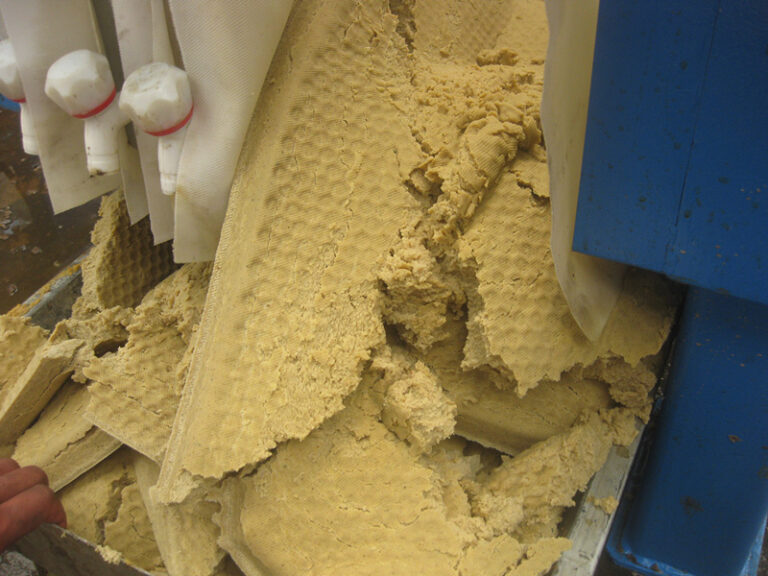

How to Reduce Filter Cake Moisture with Membrane Filter Press
The diaphragm filter press has two plates: a diaphragm plate and a standard plate. The plates are arranged in alternating layers.
For the first cycle of filtration, sludge or slurry is pumped into the chamber. The solids collect on the filter cloth, forming a filter cake. Inflation of the membrane: After the first cycle of filtering is done, the membranes in the filter plates will be filled with air or high-pressure water. This expansion puts more pressure on the filter cake, compacting it and squeezing out any remaining moisture. Squeezing out water and reducing moisture. Applying this pressure increases the dry solids concentration of the filter cake, effectively reducing its moisture content. This process makes the filter cake drier.
Membrane Filter Press Working Principle
Membrane filter press plates have a chamber below the drainage surface that can be inflated. The most common method uses water pressure. Water is pumped into the squeeze cavity to inflate the plate against the filter cake. Membrane plates are used to reduce the moisture content of the cake and shorten the filtration cycle time.
At the start of the filtration cycle, the process is similar to the Chamber Filter Press. This is called the “fill and filtration” phase. When the pressure reaches a predefined level (usually around 5–7 bar, depending on the sludge characteristics), sludge feeding is stopped. Then, rubber membranes are inflated using water or air as a squeeze medium. The cake is compressed and dewatered some more. Then, the pressure on the medium is released and the cake is removed.
For those with a filter cake washing system, the filter cake will be cleaned before unloading. This design can pass clean water through the washing port of the filter plate to clean the filter cake and remove any remaining impurities. You can also use compressed air to dry the filter cake through the washing port. This is especially helpful in industries like pharmaceuticals and food production, where filter cake purity is crucial. The washing process of membrane filter presses can be changed to meet specific needs to get the best results.
Membrane Filter Press Parameters
| Model | Filter area (m2) | Plate size (mm) | Cake thickness (mm) | Filter chamber volume (L) | Plate Quantity (pcs). | Filtration pressure (Mpa) | Motor Power(Kw) | Weight (Kg) | Dimensions LxWxH(mm) |
|---|---|---|---|---|---|---|---|---|---|
| XMGY30/870-U | 30 | 870*870 | ≤35 | 498 | 23 | ≤0.8 | 4 | 3046 | 3880*1250*1300 |
| XMGY40/870-U | 40 | 870*870 | ≤35 | 623 | 29 | ≤0.8 | 4 | 3593 | 4270*1250*1300 |
| XMGY50/870-U | 50 | 870*870 | ≤35 | 789 | 37 | ≤0.8 | 4 | 4057 | 4790*1250*1300 |
| XMGY60/870-U | 60 | 870*870 | ≤35 | 955 | 45 | ≤0.8 | 4 | 4597 | 5310*1250*1300 |
| XMGY70/870-U | 70 | 870*870 | ≤35 | 1121 | 53 | ≤0.8 | 4 | 5136 | 5830*1250*1300 |
| XMGY80/870-U | 80 | 870*870 | ≤35 | 1287 | 61 | ≤0.8 | 4 | 5636 | 6350*1250*1300 |
| XMGY50/1000-U | 50 | 1000*1000 | ≤35 | 776 | 27 | ≤0.8 | 4 | 4352 | 4270*1500*1400 |
| XMGY60/1000-U | 60 | 1000*1000 | ≤35 | 943 | 33 | ≤0.8 | 4 | 4480 | 4770*1500*1400 |
| XMGY70/1000-U | 70 | 1000*1000 | ≤35 | 1109 | 39 | ≤0.8 | 4 | 5263 | 5130*1500*1400 |
| XMGY80/1000-U | 80 | 1000*1000 | ≤35 | 1275 | 45 | ≤0.8 | 4 | 5719 | 5560*1500*1400 |
| XMGY100/1000-U | 100 | 1000*1000 | ≤35 | 1608 | 57 | ≤0.8 | 4 | 6555 | 6410*1500*1400 |
| XMGY120/1000-U | 120 | 1000*1000 | ≤35 | 1941 | 69 | ≤0.8 | 4 | 7466 | 7260*1500*1400 |
| XMGY80/1250-U | 80 | 1250*1250 | ≤40 | 1560 | 29 | ≤0.8 | 5.5 | 10900 | 4830*1800*1600 |
| XMGY100/1250-U | 100 | 1250*1250 | ≤40 | 1975 | 37 | ≤0.8 | 5.5 | 11750 | 5440*1800*1600 |
| XMGY120/1250-U | 120 | 1250*1250 | ≤40 | 2391 | 45 | ≤0.8 | 5.5 | 12600 | 6060*1800*1600 |
| XMGY150/1250-U | 150 | 1250*1250 | ≤40 | 2911 | 55 | ≤0.8 | 5.5 | 13620 | 6820*1800*1600 |
| XMGY160/1250-U | 160 | 1250*1250 | ≤40 | 3119 | 59 | ≤0.8 | 5.5 | 14470 | 7130*1800*1600 |
| XMGY200/1250-U | 200 | 1250*1250 | ≤40 | 3847 | 73 | ≤0.8 | 5.5 | 15320 | 8200*1800*1600 |
| XMGY240/1250-U | 240 | 1250*1250 | ≤40 | 4679 | 89 | ≤0.8 | 5.5 | 16170 | 9420*1800*1600 |
| XMGY250/1250-U | 250 | 1250*1250 | ≤40 | 4783 | 91 | ≤0.8 | 5.5 | 17020 | 9570*1800*1600 |
| XMGY200/1500-U | 200 | 1500*1500 | ≤40 | 3809 | 49 | ≤0.8 | 11 | 26120 | 7140*2200*1820 |
| XMGY250/1500-U | 250 | 1500*1500 | ≤40 | 4723 | 61 | ≤0.8 | 11 | 26930 | 7730*2200*1820 |
| XMGY300/1500-U | 300 | 1500*1500 | ≤40 | 5637 | 73 | ≤0.8 | 11 | 28160 | 8720*2200*1820 |
| XMGY350/1500-U | 350 | 1500*1500 | ≤40 | 6551 | 85 | ≤0.8 | 11 | 29600 | 10110*2200*1820 |
| XMGY400/1500-U | 400 | 1500*1500 | ≤40 | 7618 | 99 | ≤0.8 | 11 | 31500 | 11260*2200*1820 |
| XMGY450/1500-U | 450 | 1500*1500 | ≤40 | 8532 | 111 | ≤0.8 | 11 | 33400 | 12250*2200*1820 |
| XMGY500/1500-U | 500 | 1500*1500 | ≤40 | 9446 | 123 | ≤0.8 | 11 | 33380 | 13240*2200*1820 |
| XMGY600/2000-U | 600 | 2000*2000 | ≤40 | 11901 | 85 | ≤0.8 | 15 | 54164 | 13030*3000*2500 |
| XMGY700/2000-U | 700 | 2000*2000 | ≤40 | 13838 | 99 | ≤0.8 | 15 | 58300 | 14390*3000*2500 |
| XMGY800/2000-U | 800 | 2000*2000 | ≤40 | 14945 | 107 | ≤0.8 | 15 | 62460 | 15770*3000*2500 |
| XMGY900/2000-U | 900 | 2000*2000 | ≤40 | 17713 | 127 | ≤0.8 | 15 | 66620 | 17150*3000*2500 |
| XMGY1000/2000-U | 1000 | 2000*2000 | ≤40 | 19651 | 141 | ≤0.8 | 15 | 70780 | 18530*3000*2500 |
Free Quote

If you are interested in our products, don’t hesitate to contact us! You can contact us in any way that is convenient for you. We are available 24/7 via fax or email. You can also use the quick contact form below or visit our office. We would be happy to answer your questions.
 English
  German
  Spanish
  French
  Italian
  Russian
  Turkish
  Dutch
Dutch  Polish