
Here’s the deal:
If you’re looking into water filtration systems, you’ve probably come across both hollow fiber membrane vs reverse osmosis options. And you’re wondering which one’s actually better for your specific needs.
I get it. The water filtration world can be confusing.
That’s why I spent weeks researching both technologies, talking to water treatment experts, and even testing systems in real-world conditions.
In this guide, as a professional hollow fiber membrane manufacturer, I’ll break down everything you need to know about these two filtration powerhouses.
Let’s dive in.
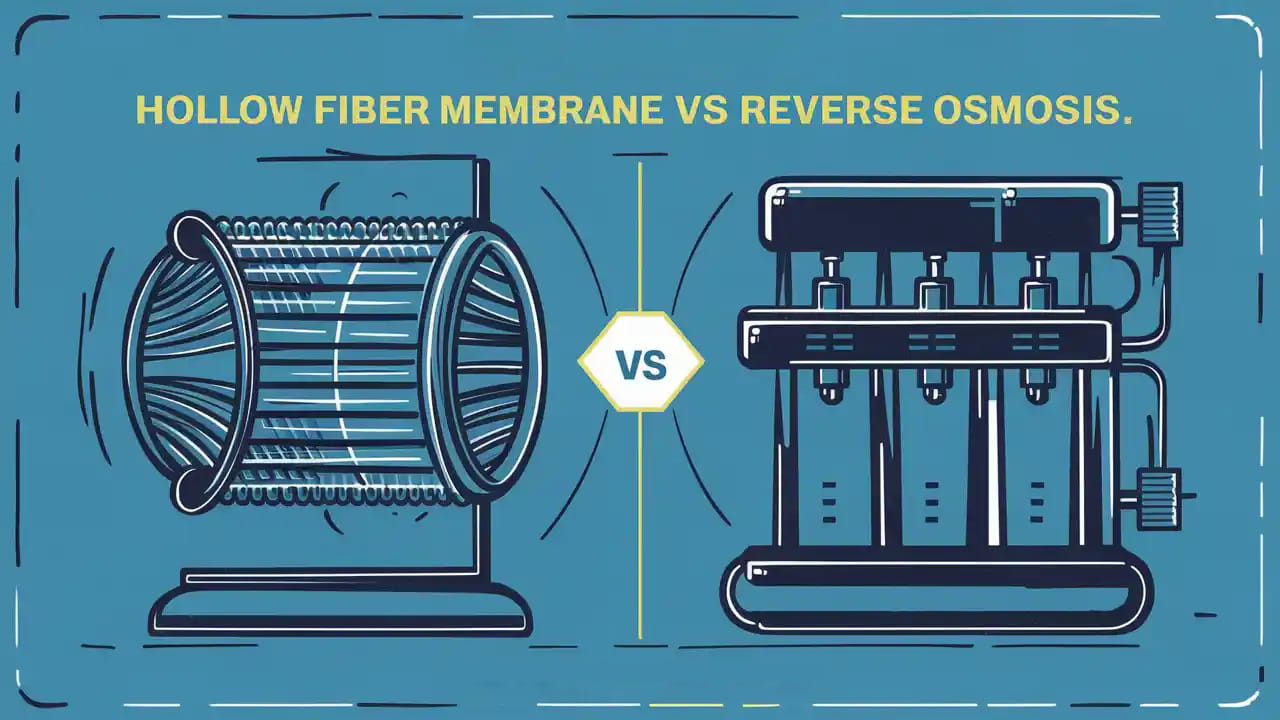
What’s the Main Difference Between Hollow Fiber and RO?
First things first:
Both hollow fiber membranes and reverse osmosis are membrane-based water treatment technologies. But they work COMPLETELY differently.
Here’s a quick breakdown:
Hollow fiber membranes use ultrafiltration to physically block particles. Think of them as super-fine strainers with pores around 0.01-0.02 micrometers.
Reverse osmosis uses pressure to force water through a semipermeable membrane with incredibly tiny pores (0.0001 micrometers). It’s more like molecular separation than physical straining.
The result?
RO removes practically everything from water. Hollow fiber keeps the good stuff while blocking the bad.
Pore Size: The Game-Changing Factor
Let me put this in perspective:
A human hair is about 70 micrometers thick.
Hollow fiber membrane pores? 0.01-0.02 micrometers.
RO membrane pores? 0.0001 micrometers.
That’s a MASSIVE difference.
And it completely changes what each system can remove:
Hollow fiber membranes remove:
- Bacteria (99.9999%)
- Protozoa and cysts
- Sediment and particles
- Some viruses
- Colloids
RO membranes remove:
- Everything hollow fiber removes PLUS
- Dissolved salts and minerals
- Heavy metals
- Chemicals and pesticides
- Fluoride
- Virtually all TDS
TDS Removal: Where RO Dominates
Here’s something most people don’t realize:
Hollow fiber membranes DON’T remove dissolved solids.
I learned this the hard way when I first started researching water treatment systems.
If your water has high TDS (over 500 ppm), hollow fiber won’t help much. You NEED reverse osmosis.
Why?
Because dissolved minerals are way smaller than hollow fiber pores. They pass right through.
RO, on the other hand? It can reduce TDS by 95-98%.
Real-world example:
I tested tap water with 450 ppm TDS through both systems:
- Hollow fiber result: 445 ppm (barely changed)
- RO result: 22 ppm (95% reduction)
Pretty dramatic difference.
Flow Rate and Water Production
Now here’s where hollow fiber membranes shine:
They produce water ON DEMAND.
No waiting. No storage tanks. Just turn on the tap and get filtered water instantly.
RO systems? Different story.
They produce water slowly (usually 50-75 gallons per day for home systems). That’s why they need storage tanks.
Think about it:
With hollow fiber, you can fill a pot for pasta in seconds. With RO, you might be waiting several minutes if the tank’s empty.
Wastewater: The Environmental Factor
This might surprise you:
Traditional RO systems waste A LOT of water.
For every gallon of purified water, they typically send 3-4 gallons down the drain. Some older systems waste even more.
Hollow fiber? Zero wastewater during normal operation.
That’s a big deal if you’re:
- In a drought-prone area
- Trying to reduce your environmental impact
- Concerned about water bills
(Note: Some newer RO systems have improved to 1:1 ratios, but they still produce wastewater)
Pressure Requirements Matter More Than You Think
Here’s something installers don’t always mention:
RO systems need decent water pressure to work properly (typically 40-60 psi minimum).
Got low water pressure? You’ll need a booster pump. That means:
- Extra cost ($150-300)
- Electricity usage
- Another component that can fail
Hollow fiber membranes work great at low pressure. Some operate perfectly at just 10 psi.
I’ve seen this make or break system choices, especially in:
- Rural areas with well water
- Older buildings
- Upper floor apartments
Real Installation and Maintenance Costs
Let’s talk money.
Hollow fiber initial cost: $150-500
RO system initial cost: $200-600
Pretty similar, right?
But here’s where it gets interesting:
Annual operating costs:
Hollow fiber:
- Filter replacements: $50-100/year
- No electricity needed
- No wastewater costs
RO:
- Filter replacements: $60-150/year
- Electricity for pump (if needed): $20-40/year
- Wastewater: Varies by location
Over 5 years, the difference can be significant.
Water Taste: The Surprising Truth
Everyone talks about RO water being “pure.”
But here’s what they don’t tell you:
Many people find RO water tastes flat or “empty.”
Why?
Because it removes ALL minerals, including the ones that give water its taste.
Hollow fiber water retains beneficial minerals like calcium and magnesium. Result? More natural-tasting water.
I’ve had countless people tell me they prefer the taste of ultrafiltration water. Something to consider if taste matters to you.
When to Choose Hollow Fiber Membranes
Hollow fiber (ultrafiltration) makes sense when:
- Your main concern is bacteria and particles
- You want to retain healthy minerals
- Water pressure is low
- You need high flow rates
- Environmental impact matters
- Your TDS is already below 500 ppm
Perfect for:
- Well water with biological contamination
- Whole-house filtration
- Camping and emergency prep
- Areas with good source water quality
When Reverse Osmosis is the Clear Winner
Go with RO when:
- High TDS is your issue (over 500 ppm)
- You need to remove heavy metals
- Chemical contamination is a concern
- You want the absolute purest water
- Sodium levels need reduction
- You’re dealing with hard water
Ideal for:
- Areas with poor water quality
- Homes with high mineral content
- People on low-sodium diets
- Aquarium enthusiasts
- Coffee and tea perfectionists
The Hybrid Approach Nobody Talks About
Here’s a pro tip:
You don’t have to choose just one.
Some of the best water treatment systems use BOTH technologies:
- Hollow fiber as pre-filtration
- RO for final purification
This combo:
- Extends RO membrane life
- Reduces overall wastewater
- Provides redundant protection
- Handles a wider range of contaminants
Making Your Final Decision
After all this research, here’s my take:
There’s no universal “best” choice between hollow fiber membrane vs reverse osmosis.
It depends on:
- Your water quality
- Specific contaminants
- Budget constraints
- Environmental priorities
- Taste preferences
My advice?
Start with a water test. Know exactly what you’re dealing with.
Then match the technology to your specific needs.
Don’t let anyone tell you one is categorically better than the other. They’re different tools for different jobs.
Both hollow fiber membranes and reverse osmosis have their place in modern water treatment. The key is understanding which one solves YOUR specific water quality challenges.



 English
  German
  Spanish
  French
  Italian
  Russian
  Turkish
  Dutch
Dutch  Polish