
Quick Summary
Filter presses achieve 40-80% cake solids through batch pressure filtration but need manual operation and 2-4 operators per shift. Centrifuges provide continuous processing at 20-60% solids with just 1 operator but cost 2-3x more initially and use 15-45 kWh/m³ versus 8-25 kWh/m³.
Choose filter press when disposal costs exceed $50/ton and maximum dryness matters; choose centrifuge for 24/7 operations above 30 m³/hour where automation is mandatory.
Ever stood in front of two industrial dewatering machines and wondered which one won’t blow your budget AND actually get the job done?
I’ve been there.
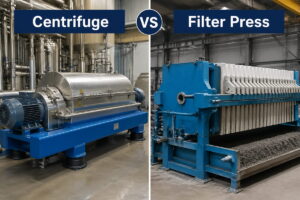
The centrifuge vs filter press debate has raged in processing plants for decades. And for good reason: picking the wrong one can cost you thousands in wasted energy, maintenance headaches, and subpar results.
Both machines separate solids from liquids. But they do it in COMPLETELY different ways. And those differences? They matter more than you might think.
In this guide, as a professional filter press manufacturer, I’ll break down exactly when to use each technology, based on real-world performance data and actual case studies from the field.
Sound good? Let’s dive in.
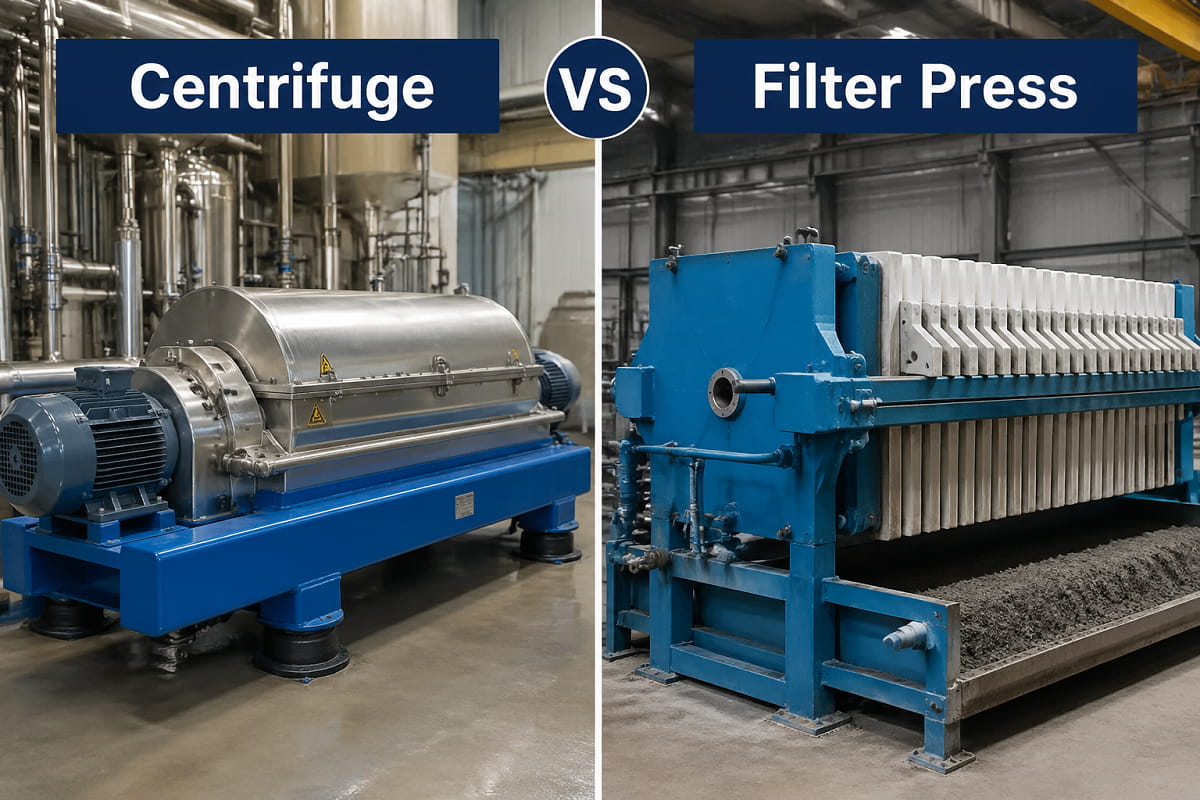
What’s the Real Difference Between These Machines?
Think of it this way:
A filter press is like squeezing a sponge with a hydraulic vise. Raw power, direct pressure, bone-dry results.
A centrifuge? More like putting that sponge in a washing machine spin cycle at 3,000 RPM. Fast, continuous, but maybe not quite as dry.
Here’s what actually happens inside each machine:
Filter Press: The Pressure Champion
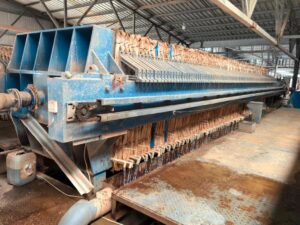
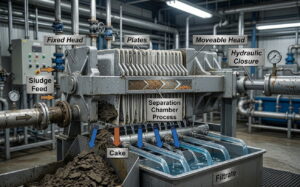
A filter press uses mechanical pressure to force liquid through filter cloths.
The process:
- Slurry pumps into chambers between filter plates
- Hydraulic pressure builds (typically 100-435 psi)
- Liquid squeezes through the cloth
- Solids compact into dense “cakes”
- Plates open, cakes drop out
It’s a batch process. Fill, squeeze, discharge, repeat.
Centrifuge: The Speed Demon
A decanter centrifuge spins your slurry at insane speeds to create artificial gravity.
Here’s how:
- Slurry feeds continuously into a rotating bowl
- G-forces (2,000-4,000x gravity) slam solids against the bowl wall
- An internal screw conveyor pushes solids toward discharge
- Clarified liquid overflows at the opposite end
- Both streams discharge continuously
No stopping. No batches. Just constant separation.
Centrifuge vs Filter Press: Detailed Comparison
Performance Showdown: By the Numbers
Let me show you how these machines ACTUALLY perform in real applications:
Cake Dryness (The Big One)
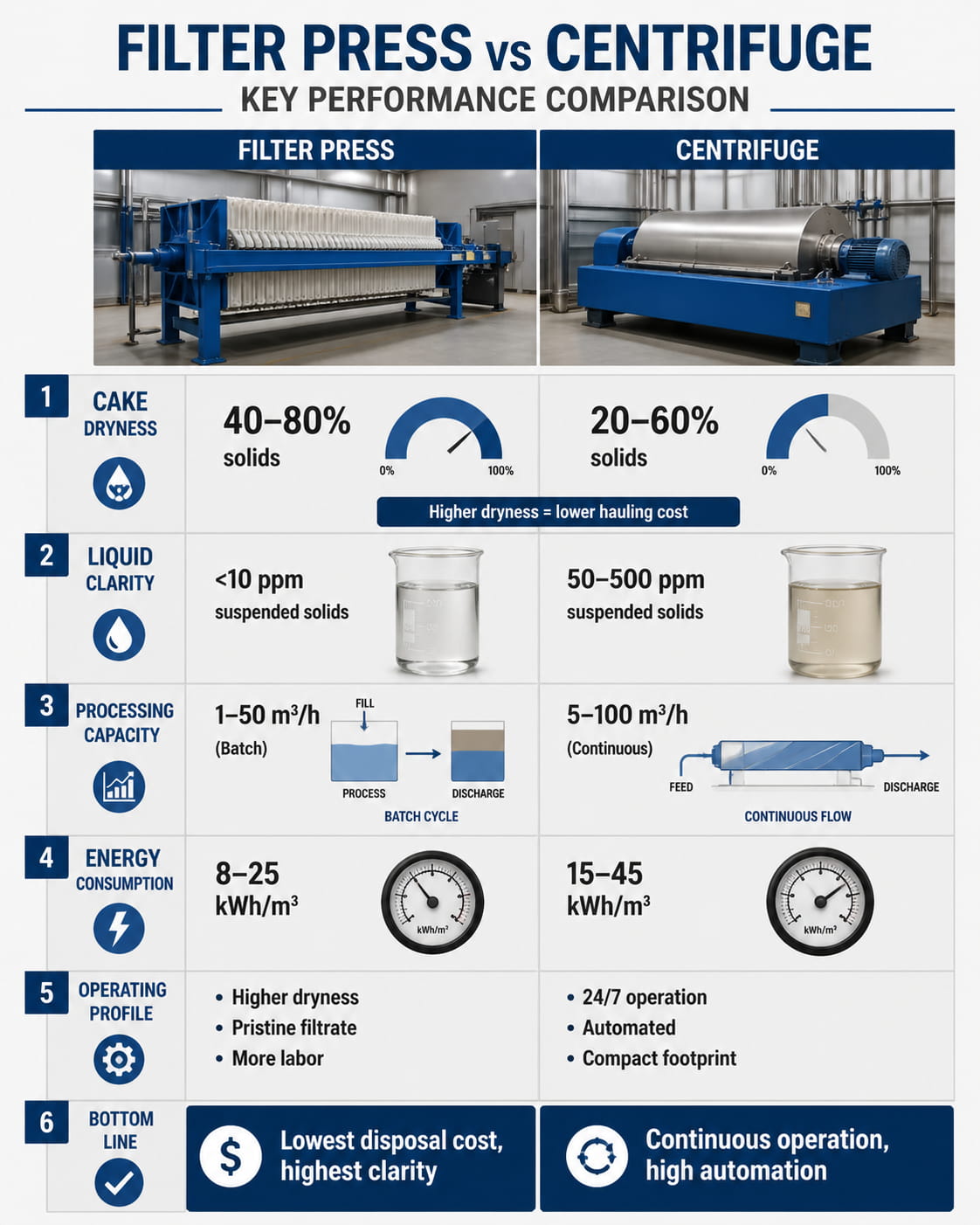
Filter Press: 40-80% solids content
Centrifuge: 20-60% solids content
Translation? A filter press can produce cakes so dry they crumble in your hand. Centrifuge cakes? Often more like thick toothpaste.
Why does this matter?
Let’s say you’re disposing of 100 tons of dry solids per month. With a filter press achieving 60% dryness, you’re hauling 167 tons total. A centrifuge at 30% dryness? You’re hauling 333 tons.
That’s DOUBLE the trucking costs.
Liquid Clarity
Filter Press: Crystal clear filtrate (often <10 ppm suspended solids)
Centrifuge: Good clarity (50-500 ppm suspended solids)
Filter cloths act as absolute barriers. If a particle is bigger than the pore size, it’s not getting through. Period.
Centrifuges rely on density differences. Fine particles or those with similar density to the liquid? They might slip through.
Processing Capacity
Filter Press: 1-50 m³/hour (batch limited)
Centrifuge: 5-100 m³/hour (continuous)
But here’s the thing:
Raw throughput numbers don’t tell the whole story. A centrifuge runs 24/7. A filter press needs downtime between batches for cake discharge and cloth cleaning.
The Cost Reality Check
I’ve analyzed dozens of installations. Here’s what the numbers really look like:
Initial Investment
Small System (10 m³/hr)
- Filter Press: $50,000-150,000
- Centrifuge: $150,000-300,000
Large System (50+ m³/hr)
- Filter Press: $200,000-500,000
- Centrifuge: $400,000-1,000,000
But wait. There’s more to this story…
Operating Costs (The Hidden Truth)
Here’s where things get interesting.
Energy Consumption
- Filter Press: 8-25 kWh/m³
- Centrifuge: 15-45 kWh/m³
A centrifuge’s massive motor runs continuously. That adds up fast.
Labor Requirements
- Filter Press: 2-4 operators per shift (manual discharge)
- Centrifuge: 1 operator for multiple units
Consumables
- Filter Press: New cloths every 500-2,000 cycles
- Centrifuge: Polymer addition often required ($$$)
Pro tip: Many operations need polymer (flocculant) to make centrifuges work effectively. This can add $50-200 per ton of dry solids processed.
Real-World Applications
I’ve seen both technologies succeed and fail spectacularly. Here’s when each makes sense:
Choose a Filter Press When:
1. Cake dryness is king
Mining operations love filter presses. Why? Shipping copper concentrate at 10% moisture instead of 25% saves massive transportation costs.
2. You need pristine filtrate
Chemical plants often require filtrate clarity that only a filter press can deliver. No fines. No contamination.
3. Your volumes are manageable
Processing 20 m³/hour in 8-hour shifts? A filter press handles this beautifully without breaking a sweat.
4. You have available labor
Got a crew that needs work? Filter press operation provides steady employment.
Choose a Centrifuge When:
1. You’re running 24/7
Municipal wastewater plants can’t stop. A centrifuge matches their continuous flow perfectly.
2. Automation is mandatory
Offshore oil platforms need equipment that runs itself. Centrifuges deliver.
3. Space is tight
A centrifuge processing 50 m³/hour fits in a shipping container. An equivalent filter press? Think warehouse.
4. Material characteristics favor it
Oily sludges, drilling muds, and fine biological solids often separate better in a centrifuge.
The Maintenance Reality
Nobody talks about this enough. But maintenance can make or break your ROI.
Filter Press Maintenance
The Good:
- Simple mechanical systems
- Most repairs doable with basic tools
- Parts readily available
The Bad:
- Cloth replacement is messy and time-consuming
- Plate shifting mechanisms wear out
- Manual cleaning between batches
Typical annual maintenance: 3-5% of capital cost
Centrifuge Maintenance
The Good:
- Self-cleaning design
- Automated operation reduces wear
- Longer intervals between major service
The Bad:
- Requires specialized technicians
- High-speed bearings = expensive replacements
- Scroll rebuild costs can hit $50,000+
Typical annual maintenance: 5-8% of capital cost
Environmental and Safety Considerations
Let’s talk about what actually happens in your plant:
Filter Press:
- Open discharge = potential spillage
- Manual handling of filter cakes
- Cloth washing creates wastewater
- Lower energy use = smaller carbon footprint
Centrifuge:
- Enclosed operation
- No manual cake handling
- Higher energy consumption
- Continuous polymer use (if required)
The bottom line? Centrifuges are cleaner but energy-hungry. Filter presses save power but need more housekeeping.
Centrifuge vs Filter Press Infographic
Advanced Selection Strategies
Here’s how the pros make decisions:
Run the Numbers (Properly)
Don’t just compare purchase prices. Calculate:
- 10-year total cost of ownership
- Cost per dry ton processed
- Disposal cost differences
- Value of recovered water
Test Your Actual Material
Lab tests lie. Pilot testing tells the truth.
Rent pilot equipment. Run YOUR slurry. Measure:
- Actual cake dryness achieved
- Polymer requirements
- Cycle times (filter press)
- Wear rates (centrifuge)
Consider Hybrid Approaches
Some plants use both. Example:
- Centrifuge for primary dewatering (bulk volume reduction)
- Filter press for final polishing (maximum dryness)
This leverages the continuous operation of centrifuges with the superior dewatering of filter presses.
Making the Final Decision
After analyzing hundreds of installations, here’s my framework:
Choose Filter Press If:
- Disposal costs > $50/ton
- Required cake solids > 35%
- Batch processing fits your operation
- Filtrate quality matters
- Labor costs < $25/hour
- Capital budget is tight
Choose Centrifuge If:
- Running continuous operations
- Space constraints exist
- Labor costs > $40/hour
- Handling > 30 m³/hour
- Material has uniform, fine particles
- Automation is mandatory
The Future of Dewatering
Technology doesn’t stand still. Here’s what’s coming:
Smart Filter Presses:
- IoT-enabled pressure monitoring
- Automatic cloth washing
- Predictive maintenance alerts
- Remote operation capabilities
Next-Gen Centrifuges:
- Variable speed optimization
- AI-powered control systems
- Ceramic wear components
- Energy recovery systems
But here’s the thing: the fundamental physics won’t change. Pressure squeezes better. Speed processes faster.
Your Action Plan
- Define your primary goal: Maximum dryness or continuous operation?
- Calculate true costs: Include labor, energy, disposal, and maintenance
- Test with your material: Never trust generic performance data
- Consider your constraints: Space, labor availability, capital budget
- Plan for the future: Where will your operation be in 5 years?
The Real Bottom Line
The centrifuge vs filter press decision isn’t about which technology is “better.” It’s about which one aligns with your specific operation.
I’ve seen plants save millions by choosing correctly. I’ve also seen operations crippled by the wrong choice.
Get this right, and you’ll optimize your entire downstream process. Get it wrong, and you’ll fight that decision every single day.
Take the time. Run the tests. Make the smart choice.
Because in the end, the best dewatering system is the one that actually works for YOUR application, not the one that worked for somebody else.



 English
  German
  Spanish
  French
  Italian
  Russian
  Turkish
  Dutch
Dutch  Polish