
Resumen rápido
Los filtros prensa consiguen una torta de sólidos de 40-80% mediante filtración a presión por lotes, pero necesitan un funcionamiento manual y de 2 a 4 operarios por turno. Las centrifugadoras permiten un tratamiento continuo de 20-60% de sólidos con un solo operario, pero cuestan 2-3 veces más al principio y consumen 15-45 kWh/m³ frente a 8-25 kWh/m³.
Elija el filtro prensa cuando los costes de eliminación superen $50/tonelada y la máxima sequedad sea importante; elija la centrifugadora para operaciones 24/7 por encima de 30 m³/hora en las que la automatización sea obligatoria.
¿Alguna vez se ha parado frente a dos máquinas industriales de deshidratación y se ha preguntado cuál de ellas no le disparará el presupuesto y hará realmente el trabajo?
Ya he pasado por eso.
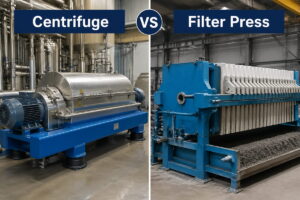
En centrifugadora vs filtro prensa En las plantas de procesado se debate desde hace décadas. Y por una buena razón: elegir la opción equivocada puede costarle miles de euros en energía malgastada, quebraderos de cabeza por el mantenimiento y resultados mediocres.
Ambas máquinas separan los sólidos de los líquidos. Pero lo hacen de maneras COMPLETAMENTE diferentes. ¿Y esas diferencias? Importan más de lo que imaginas.
En esta guía, como profesional fabricante de filtros prensa, A continuación, explicaré exactamente cuándo utilizar cada tecnología, basándome en datos de rendimiento reales y en estudios de casos reales sobre el terreno.
¿Te parece bien? Vamos a ello.
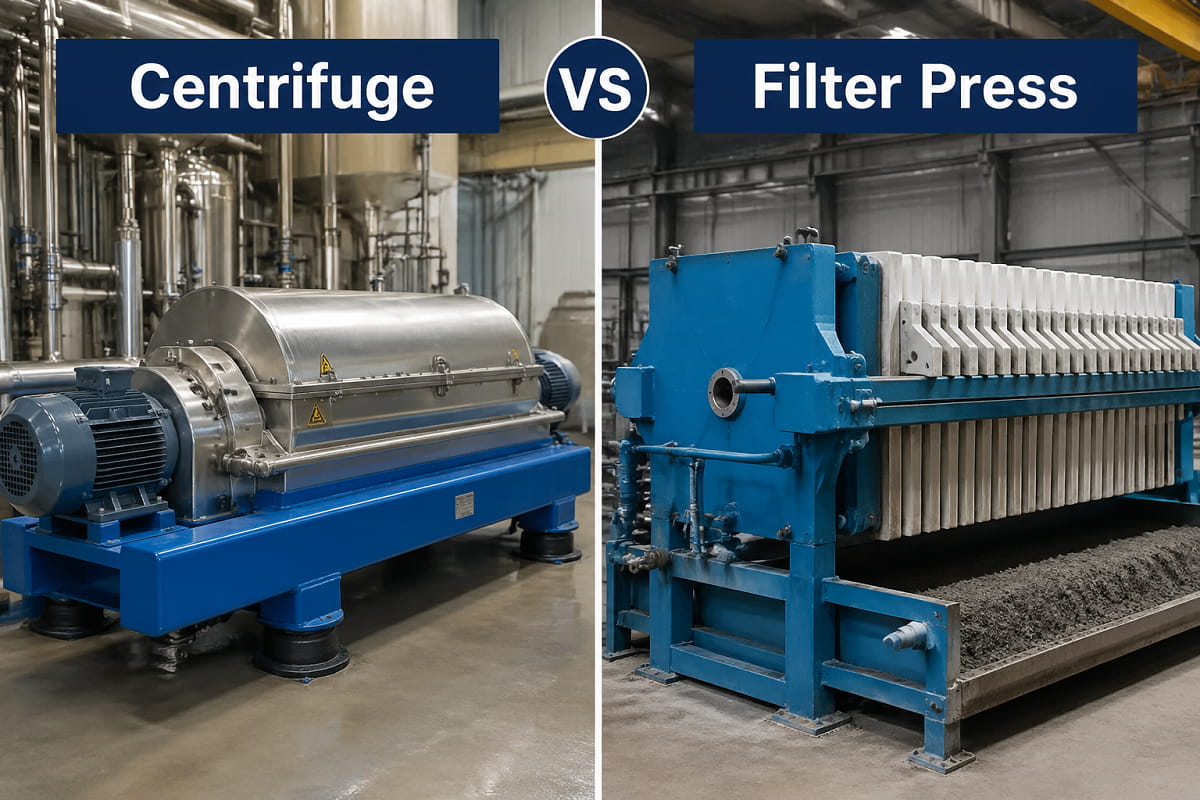
¿Cuál es la verdadera diferencia entre estas máquinas?
Piénsalo así:
Un filtro prensa es como exprimir una esponja con un tornillo de banco hidráulico. Potencia bruta, presión directa, resultados secos como huesos.
¿Una centrifugadora? Más bien como poner esa esponja en un ciclo de centrifugado de lavadora a 3.000 RPM. Rápido, continuo, pero quizás no tan seco.
Esto es lo que ocurre realmente dentro de cada máquina:
Filtro prensa: El campeón de la presión
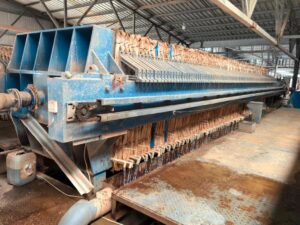
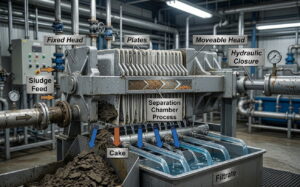
Un filtro prensa utiliza presión mecánica para forzar el paso del líquido a través de las telas filtrantes.
El proceso:
- Bombas de lodo en cámaras entre placas filtrantes
- Aumento de la presión hidráulica (normalmente 100-435 psi)
- El líquido atraviesa la tela
- Los sólidos se compactan en densas “tortas”
- Los platos se abren, los pasteles se caen
Es un proceso por lotes. Llenar, exprimir, descargar, repetir.
Centrifugadora: El demonio de la velocidad
Una centrifugadora decantadora hace girar los lodos a velocidades demenciales para crear gravedad artificial.
He aquí cómo:
- Los purines se introducen continuamente en un recipiente giratorio
- Las fuerzas G (2.000-4.000 veces la gravedad) golpean los sólidos contra la pared del recipiente.
- Un transportador de tornillo interno empuja los sólidos hacia la descarga
- El líquido clarificado rebosa por el extremo opuesto
- Ambas corrientes descargan continuamente
Sin paradas. Sin tandas. Sólo separación constante.
Centrifugadora vs Filtro Prensa: Comparación detallada
Enfrentamiento de rendimiento: En cifras
Permítanme mostrarles cómo funcionan REALMENTE estas máquinas en aplicaciones reales:
Sequedad de la tarta (la grande)
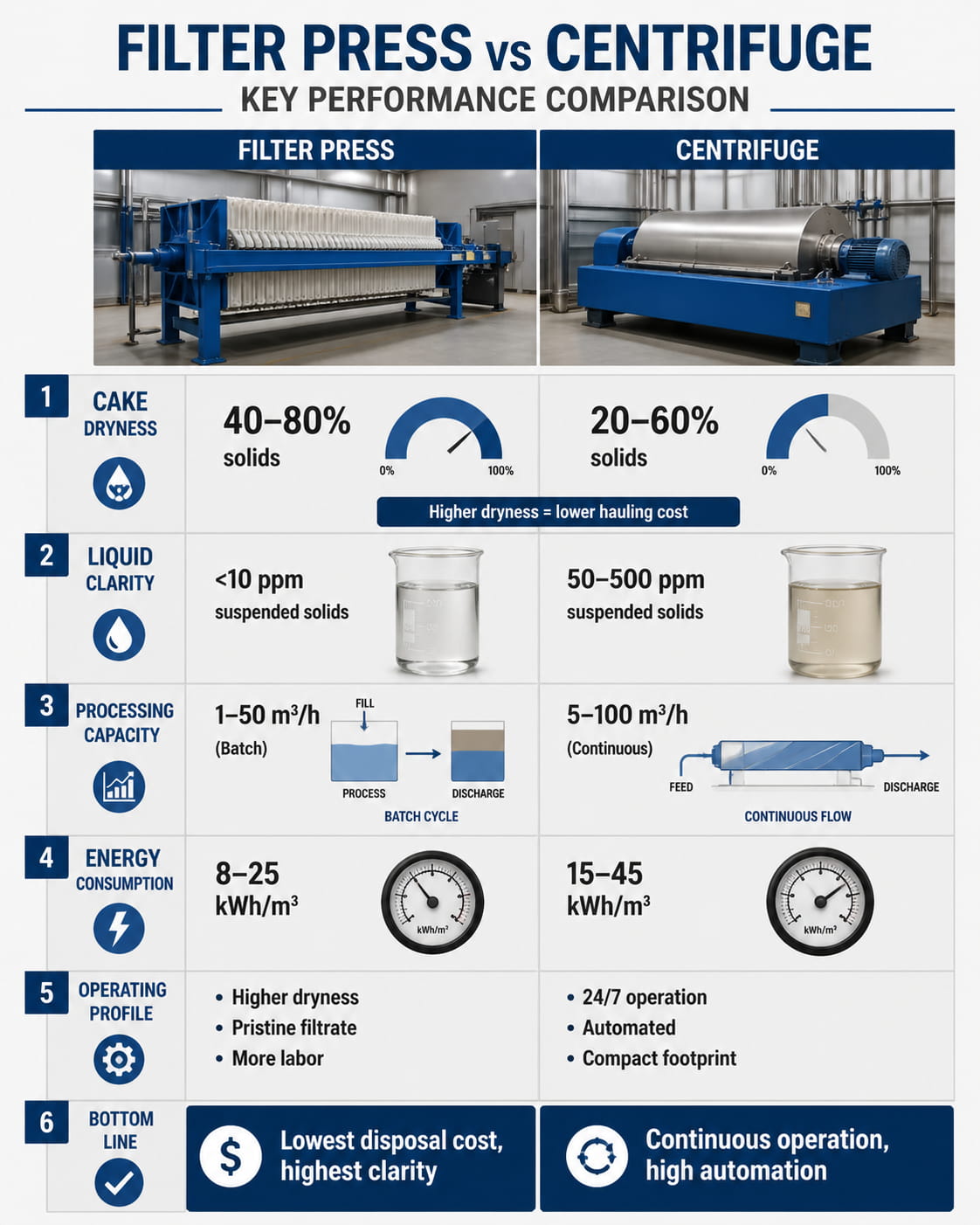
Filtro prensa: 40-80% contenido en sólidos
Centrifugadora: 20-60% contenido en sólidos
¿Traducción? Un filtro prensa puede producir tortas tan secas que se deshacen en la mano. ¿Pasteles de centrifugadora? A menudo más parecidas a una pasta de dientes espesa.
¿Por qué es importante?
Supongamos que desecha 100 toneladas de sólidos secos al mes. Con un filtro prensa que alcance una sequedad de 60%, transportará 167 toneladas en total. ¿Una centrifugadora con una sequedad de 30%? Se transportan 333 toneladas.
Eso es el DOBLE de los costes de transporte.
Claridad líquida
Filtro prensa: Filtrado cristalino (a menudo <10 ppm de sólidos en suspensión)
Centrifugadora: Buena claridad (50-500 ppm de sólidos en suspensión)
Las telas filtrantes actúan como barreras absolutas. Si una partícula es mayor que el tamaño del poro, no pasa. Y punto.
Las centrifugadoras se basan en las diferencias de densidad. ¿Partículas finas o de densidad similar a la del líquido? Podrían colarse.
Capacidad de procesamiento
Filtro prensa: 1-50 m³/hora (lote limitado)
Centrifugadora: 5-100 m³/hora (continuo)
Pero aquí está la cosa:
Las cifras de rendimiento bruto no lo dicen todo. Una centrifugadora funciona 24 horas al día, 7 días a la semana. Un filtro prensa necesita tiempo de inactividad entre lotes para descargar la torta y limpiar la tela.
La realidad de los costes
He analizado docenas de instalaciones. He aquí cómo son realmente las cifras:
Inversión inicial
Sistema pequeño (10 m³/h)
- Filtro Prensa: $50.000-150.000
- Centrifuge: $150,000-300,000
Sistema grande (más de 50 m³/h)
- Filtro Prensa: $200.000-500.000
- Centrifuge: $400,000-1,000,000
Pero espera. Hay más en esta historia...
Costes de explotación (la verdad oculta)
Aquí es donde las cosas se ponen interesantes.
Consumo de energía
- Filtro Prensa: 8-25 kWh/m³
- Centrifugadora: 15-45 kWh/m³
El enorme motor de una centrifugadora funciona continuamente. Eso se acumula rápidamente.
Requisitos laborales
- Filtro Prensa: 2-4 operarios por turno (descarga manual)
- Centrifugadora: 1 operario para varias unidades
Consumibles
- Filtro prensa: Paños nuevos cada 500-2.000 ciclos
- Centrifugadora: Polímero adición a menudo necesaria ($$$)
Consejo profesional: Muchas operaciones necesitan polímero (floculante) para que las centrifugadoras funcionen eficazmente. Esto puede añadir $50-200 por tonelada de sólidos secos procesados.
Aplicaciones reales
He visto cómo ambas tecnologías triunfaban y fracasaban estrepitosamente. He aquí cuándo tiene sentido cada una:
Elija un filtro prensa cuando:
1. La sequedad del pastel es el rey
Las explotaciones mineras adoran los filtros prensa. ¿Por qué? El envío de concentrado de cobre con una humedad de 10% en lugar de 25% ahorra enormes costes de transporte.
2. Necesita un filtrado prístino
Las plantas químicas requieren a menudo una claridad de filtrado que sólo un filtro prensa puede ofrecer. Sin finos. Sin contaminación.
3. Sus volúmenes son manejables
¿Procesar 20 m³/hora en turnos de 8 horas? Un filtro prensa lo hace de maravilla y sin sudar.
4. Dispone de mano de obra
¿Tiene un equipo que necesita trabajo? El funcionamiento del filtro prensa proporciona empleo estable.
Elija una centrifugadora cuando:
1. Estás corriendo 24/7
Las plantas municipales de aguas residuales no pueden parar. Una centrifugadora se adapta perfectamente a su flujo continuo.
2. La automatización es obligatoria
Las plataformas petrolíferas necesitan equipos que funcionen solos. Las centrifugadoras lo consiguen.
3. El espacio es reducido
Una centrifugadora que procesa 50 m³/hora cabe en un contenedor de transporte. ¿Un filtro prensa equivalente? Piense en un almacén.
4. Las características del material lo favorecen
Los lodos aceitosos, los lodos de perforación y los sólidos biológicos finos suelen separarse mejor en una centrifugadora.
La realidad del mantenimiento
Nadie habla de esto lo suficiente. Pero el mantenimiento puede hacer o deshacer su ROI.
Mantenimiento de filtros prensa
Lo bueno:
- Sistemas mecánicos sencillos
- La mayoría de las reparaciones se pueden hacer con herramientas básicas
- Piezas fácilmente disponibles
Lo malo:
- La sustitución del paño es engorrosa y requiere mucho tiempo
- Los mecanismos de cambio de placas se desgastan
- Limpieza manual entre lotes
Mantenimiento anual típico: 3-5% del coste de capital
Mantenimiento de centrifugadoras
Lo bueno:
- Diseño autolimpiable
- El funcionamiento automático reduce el desgaste
- Intervalos más largos entre revisiones importantes
Lo malo:
- Requiere técnicos especializados
- Rodamientos de alta velocidad = sustituciones costosas
- Los costes de reconstrucción pueden superar los 150.000 ¤.
Mantenimiento anual típico: 5-8% del coste de capital
Consideraciones medioambientales y de seguridad
Hablemos de lo que ocurre realmente en su planta:
Filtro prensa:
- Descarga abierta = vertido potencial
- Manipulación manual de tortas de filtración
- El lavado de ropa genera aguas residuales
- Menor consumo de energía = menor huella de carbono
Centrifugadora:
- Funcionamiento cerrado
- Sin manipulación manual del pastel
- Mayor consumo de energía
- Uso continuo de polímeros (si es necesario)
¿En resumidas cuentas? Las centrifugadoras son más limpias pero consumen más energía. Los filtros prensa ahorran energía, pero necesitan más mantenimiento.
Centrifugadora frente a filtro prensa Infografía
Estrategias avanzadas de selección
Así es como toman decisiones los profesionales:
Ejecutar los números (correctamente)
No se limite a comparar precios de compra. Calcula:
- Coste total de propiedad a 10 años
- Coste por tonelada seca procesada
- Diferencias de costes de eliminación
- Valor del agua recuperada
Pruebe su material real
Las pruebas de laboratorio mienten. Las pruebas piloto dicen la verdad.
Alquile equipos piloto. Ejecute SU lodo. Mida:
- Secado real de la torta alcanzado
- Requisitos de los polímeros
- Tiempos de ciclo (filtro prensa)
- Índices de desgaste (centrífuga)
Considerar enfoques híbridos
Algunas plantas utilizan ambas. Por ejemplo:
- Centrifugadora para deshidratación primaria (reducción del volumen a granel)
- Filtro prensa para el pulido final (máxima sequedad)
Esto aprovecha el funcionamiento continuo de las centrifugadoras con la deshidratación superior de los filtros prensa.
Tomar la decisión final
Tras analizar cientos de instalaciones, he aquí mi marco de referencia:
Elija Filtro Prensa Si:
- Costes de eliminación > $50/tonelada
- Sólidos de torta requeridos > 35%
- El procesamiento por lotes se adapta a sus operaciones
- La calidad del filtrado importa
- Costes laborales < $25/hora
- El presupuesto de capital es ajustado
Elija Centrifugadora Si:
- Funcionamiento continuo
- Existen limitaciones de espacio
- Costes laborales > $40/hora
- Manipulación > 30 m³/hora
- El material tiene partículas finas y uniformes
- La automatización es obligatoria
El futuro de la deshidratación
La tecnología no se detiene. Esto es lo que viene:
Filtros prensa inteligentes:
- Control de la presión a través de IoT
- Lavado automático de la ropa
- Alertas de mantenimiento predictivo
- Funcionamiento a distancia
Centrifugadoras de nueva generación:
- Optimización de la velocidad variable
- Sistemas de control basados en IA
- Componentes cerámicos de desgaste
- Sistemas de recuperación de energía
Pero aquí está la cosa: la física fundamental no va a cambiar. La presión aprieta mejor. La velocidad procesa mejor.
Su plan de acción
- Defina su objetivo principal: ¿Máxima sequedad o funcionamiento continuo?
- Calcular los costes reales: Incluye mano de obra, energía, eliminación y mantenimiento
- Pruebe con su material: No se fíe nunca de los datos genéricos sobre resultados
- Tenga en cuenta sus limitaciones: Espacio, disponibilidad de mano de obra, presupuesto de capital
- Planificar el futuro: ¿Dónde estará su empresa dentro de 5 años?
El verdadero balance
En centrifugadora vs filtro prensa no se trata de qué tecnología es “mejor”. Se trata de cuál se adapta mejor a sus necesidades.
He visto fábricas que ahorraban millones eligiendo correctamente. También he visto operaciones paralizadas por una elección equivocada.
Si lo hace bien, optimizará todo el proceso descendente. Si lo haces mal, tendrás que luchar contra esa decisión cada día.
Tómate tu tiempo. Haga las pruebas. Tome la decisión inteligente.
Porque al final, el mejor sistema de desagüe es el que realmente funciona para SU aplicación, no el que funcionó para otra persona.



 Spanish
  English
  German
  French
  Italian
  Russian
  Turkish
  Dutch
Dutch  Polish