
A plate and frame filter press is an indispensable piece of equipment used in various industrial filtration applications. But how exactly does this contraption work to separate liquids and solids?
In this comprehensive guide, we’ll cover everything you need to know about the working principles and operation of a plate and frame filter press.

What Is a Plate and Frame Filter Press?
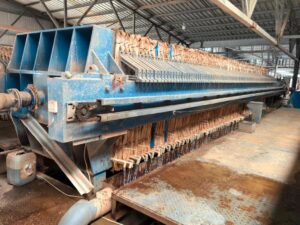
A plate and frame filter press consists of a series of vertical plates and frames assembled in an alternating pattern. The plates are covered with filter cloths and the frames have internal channels.
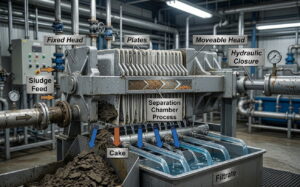
When the plates and frames are pressed tightly together by a hydraulic ram, it creates small compartments between each plate-frame pair. These compartments are known as chambers.
As slurry is pumped into the chambers under pressure, it gets dewatered through the filter cloth, forming a filter cake. The liquid that passes through the cloth is called the filtrate or the effluent. It flows through the frames into a collection pipe and exits the filter press.
Key Components:
- Filter Plates: Made of materials like polypropylene or stainless steel to withstand pressure. They contain the filter cake.
- Filter Frames: Channels inside allow the filtrate to flow out.
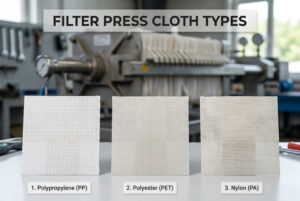
- Filter Cloths: Made of materials like polypropylene, nylon, cotton etc. Dewaters the slurry.
- Feed Pump: Delivers the slurry into the chambers under pressure.
- Hydraulic System: Applies pressure to plates and frames for filtration.
How Does a Plate and Frame Filter Press Work?
The working principle of a plate and frame filter press relies on the dewatering capability of the filter cloths under pressure. Here are the key steps:
1. Loading
The filter cloths are fixed onto the plates and frames are installed in an alternating pattern onto the filter press skeleton.
Plate and frame filter press design
2. Feeding The Slurry
The slurry or influent, which contains suspended solid particles in a liquid, is pumped at a certain pressure into the chambers by the feed pump.
3. Filtration
As the chambers fill with slurry, pressure starts building up. The liquid component passes through the filter cloths, while the solid particles begin to accumulate on the cloth surface.
4. Cake Formation
Over time, a porous mass of solids called filter cake is formed on both sides of the filter cloth in each chamber. The filter cake itself acts as an additional filter medium.
5. Filtrate Collection
The liquid filtrate flows through the internal channels of the frames into a central collection pipe via corner ports. It exits the filter press through the filtrate outlet.
6. Cake Discharge
Once the chambers are completely filled with solids and the filtration process is finished, the filter press opens. The cake falls off or is scraped out manually.
Plate and frame filter press working
This sequence repeats for the next batch. The dewatered filter cake goes for further processing while the liquid filtrate is also collected for treatment or reuse.
6 Advantages/Benefits Of a Plate and Frame Filter Press
Now that you understand what a plate & frame filter press is and how the basic filtration process works, let’s go through some of its major advantages:
1. High Filtration Efficiency
It can dewater slurries down to 30% moisture content through positive pressure filtration. This also results in extremely clear filtrate.
2. Fully Enclosed Filtration
Unlike some other filters like belt filters, the entire process happens in an enclosed chamber. This makes plate and frame filter presses excellent for handling hazardous materials.
3. Adaptability
You can use filter cloths with different materials and meshes for varied applications. Just swap them out between cycles.
4. Easy Maintenance
Maintaining a plate and frame filter press is quite straightforward – just periodically clean or replace the filter cloths. The simple design has few moving parts.
5. Space Savings
With the ability to handle high pressures and deliver high cake dryness, a plate and frame filter press provides substantial volume reduction over other separation processes. This cuts down infrastructure costs.
6. Low Operating Costs
Beyond the initial purchase cost, a plate and frame filter press is an extremely affordable filtration system to operate. Consumable costs are low and energy consumption is minimal.
Typical Applications Of Plate and Frame Filter Presses
Now that you know how a plate & frame filter press works, here are some of the most common industrial and municipal applications where they are utilized:
- Wastewater Treatment: Primary sludge dewatering, waste activated sludge filtration.
- Chemical Processing: Catalyst separation, resin recovery.
- Pharmaceuticals: API crystallization, solvent recovery, cell harvesting.
- Food & Beverage: Sugar syrup and juice clarification, extraction of oils.
- Mining: Tailings dewatering, mineral concentrate filtration.
- Metal Processing: Slag removal from molten metal, hydraulic oil purification.
- Pulp & Paper: Cellulose fiber washing, black liquor filtration.
These were just a few examples of the extremely diverse range of uses for the versatile plate and frame filter press across all types of industries.
Key Considerations While Selecting a Plate and Frame Filter Press
To conclude, here are some key parameters to consider when choosing the right plate and frame filter press for your specific needs:
- Filtration Area: Determines the throughput capacity and filtration rate.
- Cloth Material: Needs to handle your slurry composition, temperature and pressure requirements.
- Cake Thickness: Select frame depth based on desired cake dryness.
- Level Of Automation: Manual, semi-automatic or fully automatic?
- Additional Features: Consider chamber plates for pre-coating, drip trays, and other optional accessories.
- After-Sales Support: Ensure timely provision of spare parts, maintenance and other services.
With their simple yet rugged design and excellent performance, it’s no wonder plate and frame filter presses continue to be ubiquitous across industrial filtration processes for over a century. I hope this guide helped you achieve crystal clarity on what this apparatus is and how it manages to separate crystals!




 English
  German
  Spanish
  French
  Italian
  Russian
  Turkish
  Dutch
Dutch  Polish