
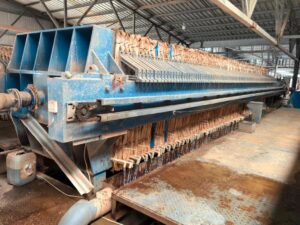
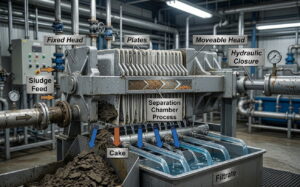
Filter presses are industrial machines used to separate liquids and solids in a slurry. They work by pumping the slurry into chambers made up of filter plates. Pressure forces the liquid through the filter media (filter cloth), while the solids remain behind in the form of a solid “cake”.
Filter presses have a wide range of applications across many industries like mining, wastewater treatment, chemical processing, food production, battery recycling and more. In this guide, as a professional filter press manufacturer, we’re going to cover exactly how filter presses work and what makes them so useful for liquid-solid separation.

How Filter Presses Work
The working principle of a filter press relies on pressure filtration. Here are the key steps:
- Slurry Enters the Filter Press: The liquid-solid slurry mixture is pumped into the filter press from a feed tank or directly from a process stream.
- Fill Cycle: During the fill cycle, the slurry fills the chambers between the filter plates. The liquid passes through small openings in the filter cloths, while solids begin to build on the cloth surface.
- Pressure Builds: A pump applies pressure (21-30 bars typically) to the slurry, compacting the filter cake and squeezing more liquid through with time.
- Filtration Cycle Ends: Once the chambers fill with solids and a satisfactory dry cake is formed, the filtration cycle ends by closing the slurry feed valve.
- Discharge Cycle: After draining remaining liquid, the plates shift apart and the filter cake discharges. Then the cycle repeats.
An automatic filter press can run this sequence continuously without the need for manual intervention between batches. The key components that enable solid/liquid separation in a filter press include:
- Filter Plates: Stacked metal plates sealed with gaskets form hollow chambers.
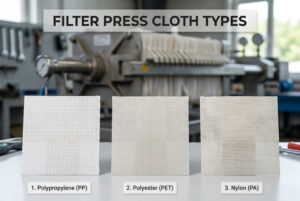
- Filter Cloth: Specialized cloths line each chamber provide the filter medium.
- Piping & Manifolds: Route slurry in and filtrate out of the press.
- Hydraulics or Mechanical Presses: Apply pressure to the slurry.
Now let’s go over why filter presses are used across so many industries.
What Are Filter Presses Used For
Filter presses offer highly efficient solid/liquid separation. This capability makes them key parts of processes across many sectors:
Wastewater Treatment
Municipal and industrial wastewater plants use filter presses to dewater sludge. Removing water reduces sludge volume, cutting disposal costs. Filtered water can also be treated and reused.
Food & Beverage Processing
Filter presses clarify juices, sugar syrups, wines and remove yeast from beer without affecting taste and texture. Solid portions can be reclaimed as cattle feed or fertilizers.
Mining & Aggregates
Mines use filter presses to reclaim water from tailings and recover valuable minerals. Presses also dewater aggregates during recycling and wash water purification.
Chemical Processing
Filter presses remove crystals, resins and precipitated solids from reactors, while recovering soluble products from waste streams, improving yields.
Metal Finishing
Plating bath dumps and rinse water streams get filtered to remove heavy metals, allowing reuse/disposal of clarified water based on contamination levels.
Battery Recycling
Filter presses recover lead paste or powders from sulfuric acid leach solutions in lead-acid battery recycling plants in an eco-friendly process.
Pharma & Biotech
Filter presses clarify antibiotics, biopolymers like xanthan gum, proteins from fermentation broths and sterilize vaccine solutions while collecting cells or bio-solids.
As you can see, filter presses handle widely varying slurries across every industry that produces or utilizes suspensions, pastes,precipitates in liquids – basically anywhere solid/liquid separation is needed.
Next, let’s go over why filter presses offer key advantages over other liquid/solid separators.
Benefits of Using Filter Presses
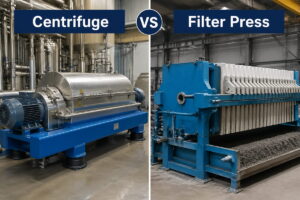
While technologies like centrifuges and belt filter presses also perform liquid/solid separation, filter presses offer unique advantages:
Highly Efficient Dewatering – Filter presses remove up to 90% of liquids from many slurries, producing solid filter cakes. Centrifuges and belt presses cannot match this performance.
Fully Enclosed Operation – Since filtering happens in closed chambers, no exposure to hazardous or volatile slurries during processing.
Space Savings – Compared to belt presses and settling ponds, filter presses offer substantial space savings.
Cost Savings – With minimal moving parts, filter presses also have lower energy and maintenance costs compared to centrifuges.
Process Flexibility – Filter presses can handle slurries with up to 80% solids concentration, from acids to abrasives. Media can target specific particle sizes.
Sanitary Construction – Stainless steel filter presses serve food, pharmaceutical and biotech sectors where sanitation and purity are critical.
Automation – Fully automatic filter press operation enables hands-off continuous processing without manual plate shifting.
With the right combination of plates, cloth, pumps and ancillary equipment, a filter press can efficiently separate nearly any liquid/solid mixture.
Key variables that impact performance include particle size, percent solids, filtrate clarity level needed and batch cycle time. An expert vendor like Water Treatment Suppliers can help identify the optimal filter press configuration and capacity for your specific process needs after a thorough assessment.
How to Choose the Right Filter Press
With so many types of filter press designs available today, selecting one suited for your application requires careful consideration of multiple factors:
- Solids Loading Rate – Impacts capacity needs and cloth selection.
- Filtrate Clarity – Clarification level affects plate and cloth type, washing needs etc.
- Percent Solids – Impacts feed slurry properties and pre-treatment approaches.
- Hydrodynamics – Pressure balances and flow uniformity affect performance.
- Throughput Goals – Batch and continuous process targets dictate press size and automation levels.
Evaluating process conditions and goals allows proper selection of design (plate and frame, membrane, automatic, etc), materials (stainless, carbon steel, exotic alloys), plate size, closure system (hydraulic, pneumatic or manual), and cake discharge method (automatic or manual).
Key filter press vendors like Water Treatment Suppliers, Optimation, Sparkler, Nirmal among others offer extensive application expertise. Working closely with your chosen supplier is highly recommended to ensure optimal press sizing and configuration.
Conclusion
With capabilities to efficiently separate liquids and solids in an enclosed system, filter presses are integral to processes across industries. They outperform other technologies in dewatering effectiveness, process control and cost savings.
However, optimal selection and operation of filter presses relies on factors like feed material properties, throughput targets and clarity requirements. Finding the right combination of design, size, materials, ancillary systems etc necessitates careful planning by knowledgeable specialists.
By partnering with expert vendors and integrating presses into existing infrastructure appropriately, businesses can meet their solid/liquid separation goals reliably over decades, boosting sustainability and profitability.



 English
  German
  Spanish
  French
  Italian
  Russian
  Turkish
  Dutch
Dutch  Polish