
Have you heard the phrase “filter press cake” and wondered what exactly it refers to? As an important concept in liquid-solid separation, understanding filter cake is key for anyone working with filtration equipment.
In this complete guide, as a professional filter press manufacturer, we’ll cover everything you need to know, including:
- What is filter press cake?
- How filter press cake is formed
- Properties and characteristics of filter press cake
- Moisture content and dryness
- Testing and analysis
- Benefits and drawbacks of filter press cake

Quick Summary
- Filter press cake is the compacted solid layer formed on filter cloths during pressure filtration.
- Its permeability, compressibility, and moisture content determine filtration efficiency and discharge behavior.
- Dryness can be improved by adjusting pressure, cycle time, feed rate, or using membrane squeeze, cake blowing, and chemical preconditioning.
- Testing cake moisture and structure helps optimize operating conditions and identify filtration limits.
What Is Filter Press Cake?
Filter press cake refers to the solid material that accumulates on the filter cloth inside a filter press during the filtration process. It’s essentially a layer of dewatered solids that builds up within the press.
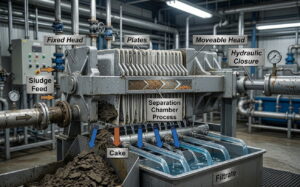
As slurry enters the chambers of the filter press, solid particles collect on the surface of the filter cloth. These solids accumulate over time, aided by pressure, forming a porous mass known as filter cake.
Meanwhile, the liquid component of the slurry (the filtrate) passes through tiny openings in the filter cloth, exiting the chambers. So the cake contains the solid material while allowing separation of the liquid.
How Filter Press Cake Is Formed
When slurry first enters a filter press, individual solid particles collect directly on the filter cloth surface. This forms a thin layer known as the filter medium.
Initially, some finer particles may penetrate the cloth. But rapidly, larger particles bridge the gaps in the cloth, blocking openings and enhancing filtration efficiency.
As more solid material accumulates, it compacts tightly due to pressure within the chambers. This compression, combined with ongoing particle capture, leads to a thicker and denser filter cake.

The filter cake structure continues developing throughout the filtration cycle. The key factors governing cake properties are:
- Particle size distribution (PSD) – Smaller particles pack more tightly, resulting in lower permeability. Larger particles tend to form more porous structures.
- Particle shape – Jagged, angular particles don’t pack as neatly as rounded media, leaving more void spaces for liquid flow.
- Surface chemistry – Certain materials more readily hold onto thin liquid films via molecular adhesion and surface tension.
- Pressure – Higher pressure compacts particles more forcefully, expelling additional liquid.
Key Properties and Characteristics of Filter Press Cake
Filter cakes have various properties and characteristics that determine filtration performance:
Permeability
This vital property indicates how easily liquid flows through the structured network of solid particles. High permeability enables good throughput and filtration efficiency.
Porosity
Porosity refers to the pore volume contained within the cake – void spaces between particles where liquid accumulates. Higher porosity means more capacity for hosting liquid.
Compressibility
This indicates how much the cake structure deforms under pressure. Highly compressible cakes compact more tightly, expelling more liquid.
Wettability
Wettability reflects how readily the particles attract and cling to liquid via surface chemistry interactions. Low wettability enables more moisture removal.
Cohesiveness
Cohesive cakes are clingy and sticky. Such cakes resist deformation and liquid expulsion. Cakes with low cohesion separate more easily upon discharge.
Permeability changes
Some filter cakes display variable permeability under pressure. Certain clays deform and become tightly packed, blocking flow under compression.
Shrinkage and cracking
As moisture reduces, cakes shrink and develop cracks that can allow liquid channels to reopen. This provides pathways for ongoing dewatering.
Moisture Content and Dryness
A key function of filter presses is dewatering slurry to produce a drier solid material. The effectiveness of this separation is measured using two parameters:
Percent solids
This indicates the proportion of bone-dry solids within the filter cake by mass. Higher values reflect a drier product.
Percent moisture
Conversely, this metric represents the mass fraction still consisting of liquid, principally water. Lower moisture contents signal better separation.
Producing filter cake with very high percent solids requires optimal process conditions and press configurations. Steps like cake blowing and membrane squeezing physically expel additional liquid.
Analyzing moisture provides vital insights into achieving target dryness. It also indicates how various parameters influence dewatering effectiveness.
How to Dry Filter Press Cake
Optimizing Operating Parameters
One of the easiest ways to enhance filter press cake dryness is to optimize the operating parameters. This requires no equipment changes – just adjustments to your current process.
Increase Pressure
Higher pressure forces more liquid out of the cake during the filtration cycle. Most filter presses are designed for pressures between 100-500 PSI.
Boost your pressure towards the higher end of the range. Be aware that extremely high pressures can damage plates.
Extend Filtration Time
The longer cake remains compressed under pressure, the more moisture is removed. Filtration times often range from 30 minutes to 2 hours.
Test extending your normal cycle in 15-30 minute increments to find the optimum time for your application. Just be wary of diminishing returns after a certain point.
Lower Feed Flow Rate
Reducing the flow rate of slurry into the filter press allows more time for liquid to migrate out of the cake.
Try cutting your normal feed rate in half. This gentler filling better facilitates dewatering without harming wash quality.
Employing Auxiliary Measures
Beyond adjusting operating parameters, auxiliary techniques can further enhance cake dryness:
Membrane Squeeze
Membrane plates utilize inflatable diaphragms that compress the cake when activated. This additional squeeze force liberates significantly more liquid.
Be aware that membrane squeeze works best for compressible cakes. Adjust pressure so plates don’t rupture.
Cake Blowing
Cake blowing involves shooting compressed air through formed cakes after the filtration cycle finishes. This air flow effectively “blow drys” the cake by displacing moisture.
Work air supply equipment into your existing system for automated blow drying. Humidity measurement before and after will indicate efficacy.
Preconditioning Agents
Certain chemicals alter slurry characteristics to improve dewatering properties. Common examples include:
- Flocculants – Clump fine particles so water flows easily
- Coagulants – Bind molecules so cakes filter faster
- Surfactants – Change surface chemistry to repel water
Dose these ahead of the filter press to precondition the slurry for drier cake. Overuse can make cloth cleaning difficult.
Cloth Treatment
Special chemical coatings applied to filter cloths modify surface properties to reduce sticking and cake moisture.
Cloth impregnation typically takes place during off-hours. Reapply after routine cloth cleaning for maintained effects.
Chamber Modifications
Altering the internal channels and ports enables better liquid flow out while retaining solids. This positively influences residual moisture.
Upgrading older model plates to current chamber configurations greatly enhances dewatering.
Testing and Analysis
Evaluating filter press cake provides beneficial diagnostics on filtration performance. Here are some key testing activities:
Moisture analysis
Lab testing determines precise percent solids figures. Comparing feed, intermediate, and final moisture reveals the rate and extent of drying.
Permeability measurements
Specialized rigs measure how easily air or liquid flows through a filter cake sample under controlled conditions. Results help size equipment and predict filtration rates.
Zeta potential
This technique indicates particle surface chemistry. It provides useful insights into surface interactions, adsorption effects, and liquid adhesion tendencies.
Microscopy
Using microscopes to observe cake structure shows the orientation and packing density of particles. It also reveals post-filtration shrinkage and cracking characteristics.
X-ray tomography
Advanced three-dimensional imaging can map the complex pore structure within filter cakes. This enables detailed analysis of porosity and permeability.
Ongoing cake property measurement combined with filtration data helps identify optimum operating conditions. It also flags any process upsets that allow excessive liquid carryover within the cake.
Benefits and Drawbacks of Filter Press Cake
The formation of filter press cake has several advantages for solid-liquid separation:
High filtration efficiency – By capturing particles, the cake prevents solids escaping with the filtrate. This maximizes dewatering performance.
Protects filter cloth – The cake shields the fine filter cloth pores from abrasion and blockages, extending cloth lifetime.
Enables compression – Consolidating the cake structure under pressure forces out additional liquid.
Cake washing – Impurities can be flushed from the cake by filtrate flow prior to discharge.
However, there are also some disadvantages:
Resistance to flow – The filtration resistance rises over time as cake accumulates, slowing liquid discharge.
Liquid retention – Wettability effects can cause liquid adhesion and retention within the cake pore network.
Sticky discharge – Cohesive, compressible cakes resist discharge and cling to filter cloths. Efficient, complete discharge is vital.
Conclusion
In summary, filter press cake consists of dewatered particulate solids accumulating on filter cloths during pressure filtration.
Understanding cake properties provides key insights for achieving optimal performance from filter press separation. Targeting the ideal cake structure and moisture content is an essential focus for efficient operations.
Analyzing cake samples also indicates how effectively filtration is progressing. This helps identify optimum process conditions and troubleshoot any emerging issues proactively.
By considering cake formation fundamentals and characteristics, specialists can leverage filter presses to deliver exceptional solid-liquid separation outcomes across diverse industrial contexts.





 English
  German
  Spanish
  French
  Italian
  Russian
  Turkish
  Dutch
Dutch  Polish