
So you need to choose a filter cloth for your filter press.
And you’re probably wondering: “Which type is actually going to work for MY specific application?”
Picking the wrong filter cloth can literally tank your entire filtration operation. We’re talking poor cake release, constant blinding, torn cloths, and filtrate that looks like chocolate milk.
But when you nail the right filter press cloth types for your setup? Your press runs like a dream. Clean filtrate. Easy cake release. Minimal downtime.
In this guide, as a professional filter press manufacturer, I’ll break down exactly how to choose the perfect filter cloth for your specific needs.
Let’s dive in.
What Are Filter Press Cloths (And Why Should You Care)?
Filter press cloths are the actual barrier that separates solids from liquids in your press.
Think of them as the goalkeeper in soccer. Without a good goalkeeper, you’re toast. Same deal with filter cloths.
Here’s what makes them so critical:
The cloth material determines what chemicals you can filter
The weave pattern affects how easily your cake drops
The fiber type impacts how small of particles you can capture
Get any of these wrong? You’re looking at constant maintenance headaches and poor filtration quality.
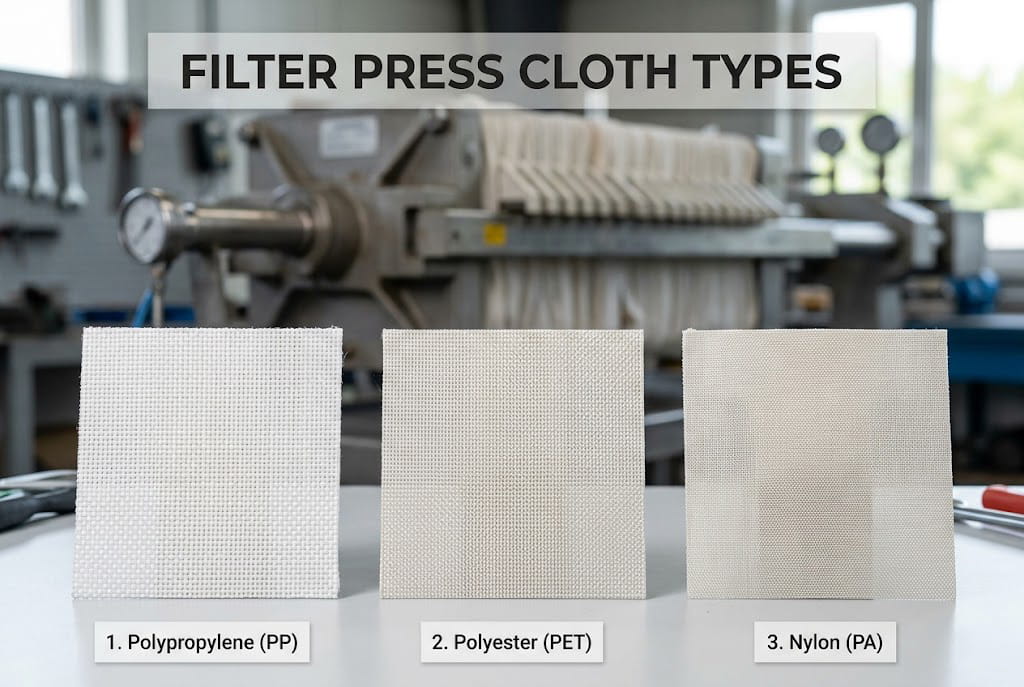
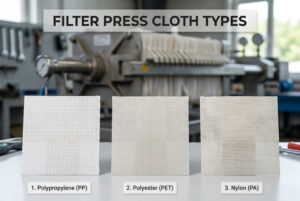
The 3 Main Filter Press Cloth Material Types
Let me break down the heavy hitters in the filter cloth world.
1. Polypropylene (PP)
Polypropylene is like the Swiss Army knife of filter cloths.
Why PP rocks:
- Handles acids AND bases like a champ
- Works up to 90°C (194°F)
- Won’t break the bank
- Naturally hydrophobic (repels water)
Best for: Chemical processing, wastewater treatment, and pretty much any application where you need solid all-around performance.
I’ve seen PP cloths handle everything from mining slurries to pharmaceutical waste. They just work.
2. Polyester (PET)
Need to filter something hot? Polyester’s your best bet.
Key benefits:
- Handles temps up to 130°C (266°F)
- Excellent acid resistance
- Great for capturing fine particles
- Strong and durable
Watch out: Polyester hates strong alkalis. If your pH regularly hits 12+, look elsewhere.
Perfect for: High-temperature applications, food processing, and anywhere you need super-fine filtration.
3. Nylon (PA)
Nylon filter cloths are the bodybuilders of the filter press world.
What makes nylon special:
- Incredible abrasion resistance
- Loves alkaline environments
- Flexes without breaking
- Operates up to 110°C (230°F)
The catch: Acids are nylon’s kryptonite. Keep it away from anything below pH 4.
Ideal applications: Mining operations with abrasive slurries, alkaline chemical processing, and heavy-duty industrial use.
Weave Patterns: The Secret to Perfect Cake Release
Here’s where things get interesting.
The way your cloth is woven dramatically impacts performance. Let me show you the main players:
Plain Weave – The Precision Expert
Picture a checkerboard pattern. Over, under, over, under.
Pros:
- Captures the tiniest particles
- Super strong construction
- Consistent pore size
Cons:
- Terrible cake release
- Blinds easily
- Slower flow rates
Use when: You absolutely need crystal-clear filtrate and don’t mind longer cycle times.
Twill Weave – The Middle Ground
See those diagonal lines running through the fabric? That’s twill.
Why I like twill:
- Better flow rates than plain weave
- Decent cake release
- Still captures particles well
- More flexible
Best for: General-purpose filtration where you need a balance of clarity and productivity.
Satin/Sateen Weave – The Cake Release Champion
This is the Ferrari of cake release. Seriously.
The magic of satin weave:
- Cake practically falls off
- Smooth surface = less blinding
- Fast cycle times
- Easy to clean
Trade-off: Slightly larger pore openings mean less particle retention.
Perfect when: Your slurry is sticky and cake release is your #1 priority.
Fiber Types: Monofilament vs. Multifilament
This choice can make or break your filtration efficiency.
Monofilament – The Clean Operator
Think of monofilament like fishing line. Single, smooth strands.
Why monofilament rocks:
- Phenomenal cake release
- Resists blinding
- Easy to clean
- Consistent pore size
The downside: Larger pore openings = cloudier filtrate
Multifilament – The Fine Filtration Master
Hundreds of tiny fibers twisted together.
Multifilament advantages:
- Catches the smallest particles
- Creates dense filter cakes
- Maximum clarity
But watch out for:
- Particles getting stuck in the yarn
- Harder to clean
- Slower dewatering
The Smart Compromise: Mono-Multi Hybrids
Want the best of both worlds?
Mono-multi cloths use monofilament in one direction (usually warp) and multifilament in the other (weft).
Result? Good cake release AND solid particle capture.
(This is what I recommend for 80% of applications.)
Real-World Selection Process
Let me walk you through exactly how to pick the right cloth.
Step 1: Know Your Enemy (The Slurry)
First, answer these questions:
What’s your pH?
- Below 4? Avoid nylon
- Above 12? Skip polyester
- Anywhere from 4-12? PP is your friend
What’s the temperature?
- Under 90°C? Any material works
- 90-130°C? Go polyester
- Room temp? Save money with PP
How abrasive is it?
- Highly abrasive? Nylon or heavy-duty PP
- Non-abrasive? Standard PP or polyester
Step 2: Define Your Filtration Goals
Need crystal-clear filtrate?
Choose multifilament + plain weave
Want fast cycle times?
Pick monofilament + satin weave
Looking for balance?
Try mono-multi + twill weave
Step 3: Consider Your Operation
Manual plate shifting?
Light, flexible cloths make life easier
Automatic press?
Go for durability over handling
Frequent cloth changes?
Prioritize cost-effectiveness
Advanced Tips From the Trenches
After helping dozens of operations optimize their cloth selection, here’s what actually moves the needle:
The Permeability Sweet Spot
Permeability (measured in L/dm²·min) is crucial.
Too high? Your filtrate looks terrible.
Too low? Cycle times drag on forever.
My rule of thumb:
- Chemical/pharmaceutical: 15-50 L/dm²·min
- Mining/aggregate: 100-300 L/dm²·min
- Wastewater: 50-150 L/dm²·min
The “Sticky Cake” Solution
Got a slurry that sticks like glue?
Here’s the combo that works 90% of the time:
- Satin weave pattern
- Monofilament construction
- Surface treatment (calendared or Teflon-coated)
Your cakes will drop like they’re on ice.
When to Use Latex Edge Sealing
Non-gasketed plates? Latex edge sealing is a game-changer.
It creates a better seal between cloth and plate, which means:
- Less mess
- Better cake formation
- Longer cloth life
Worth the extra cost? Absolutely.
Common Mistakes to Avoid
I see these errors constantly:
Mistake #1: Choosing based on price alone
Cheap cloths = frequent replacements = higher total cost
Mistake #2: Ignoring chemical compatibility
Wrong material + wrong chemical = dissolved cloth
Mistake #3: Over-specifying filtration
Not every application needs 1-micron clarity
Mistake #4: Forgetting about cake release
The best filtration means nothing if your cake won’t drop
Industry-Specific Recommendations
Let me save you some trial and error:
Mining and Minerals
- Material: Nylon (for durability)
- Weave: Twill or satin
- Construction: Heavy-duty monofilament
Chemical Processing
- Material: Polypropylene
- Weave: Depends on particle size
- Construction: Mono-multi for versatility
Wastewater Treatment
- Material: Polyester or PP
- Weave: Twill
- Construction: Standard multifilament
Food and Beverage
- Material: FDA-approved PP
- Weave: Plain or twill
- Construction: Multifilament for clarity
Making the Final Decision
Here’s my simple framework:
- Eliminate incompatible materials (based on pH and temperature)
- Match weave to your priorities (clarity vs. productivity)
- Choose fiber type (based on particle size)
- Consider your budget (but factor in lifespan)
- Order samples and test
That last point? Super important.
Any reputable supplier will send samples. Test them with YOUR slurry under YOUR conditions.
The Bottom Line on Filter Press Cloth Types
Choosing the right filter cloth isn’t rocket science. But it does require understanding your specific needs.
Start with chemical compatibility. Then optimize for your main priority (clarity, cake release, or durability). Finally, test before committing to a large order.
Get this right, and your filter press will run smoothly for years.
Get it wrong? Well, let’s just say you’ll become very familiar with your cloth supplier’s phone number.
The good news? Now you know exactly what to look for in filter press cloth types. Time to put this knowledge to work and optimize your filtration operation.



 English
  German
  Spanish
  French
  Italian
  Russian
  Turkish
  Dutch
Dutch  Polish