
Ever wondered why some filter presses run like clockwork while others constantly need maintenance?
Here’s the deal: filter press cloth material is the make-or-break factor in your filtration system.
Think about it. Your filter cloth is literally the barrier between success and failure. Pick the wrong material? You’re looking at constant downtime, torn cloths, and filtration that barely works.
But choose the right material? Your press runs smoothly, cycle times drop, and maintenance becomes a breeze.
I’ve seen companies slash their operating costs by 40% just by switching to the right cloth material. No fancy equipment upgrades. No complex process changes. Just the right fabric doing its job.
In this guide, as a professional filter press manufacturer, I’ll break down everything you need to know about selecting the perfect filter press cloth material for your operation.
Sound good? Let’s dive in.
Quick Summary:
- Match cloth to process conditions: temperature, pH, particle abrasiveness and chemical exposure are decisive.
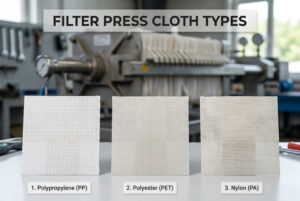
- Polypropylene is the versatile, cost-effective default; polyester (PET) for high heat; nylon for abrasive slurries; cotton only for very specific low‑risk uses.
- Account for yarn type (mono vs multifilament), weave and permeability, and test cloths before full adoption.
- Evaluate true cost of ownership (purchase price, lifespan, downtime, cleaning and lost production) rather than initial price alone.
Why Filter Press Cloth Material Matters More Than You Think
Let me paint you a picture.
You invest $100,000 in a state-of-the-art filter press. Top-of-the-line pumps. Automated controls. The works.
But you cheap out on the filter cloth.
Six months later? You’re replacing torn cloths every few weeks. Your filtrate looks cloudy. And that expensive press is sitting idle half the time.
The bottom line? Your filter cloth is where the rubber meets the road.
Here’s what the right material does for you:
- Maximizes throughput (I’m talking 20-30% increases)
- Extends cloth life from months to years
- Improves cake release so you spend less time cleaning
- Reduces chemical costs through better resistance
- Cuts energy usage with optimized permeability
But here’s the thing: There’s no one-size-fits-all solution.
The cloth that works perfectly for mining slurry will fail miserably in a chemical plant. And what handles wastewater like a champ might dissolve in your specific process.
That’s why understanding each material’s strengths and weaknesses is crucial.
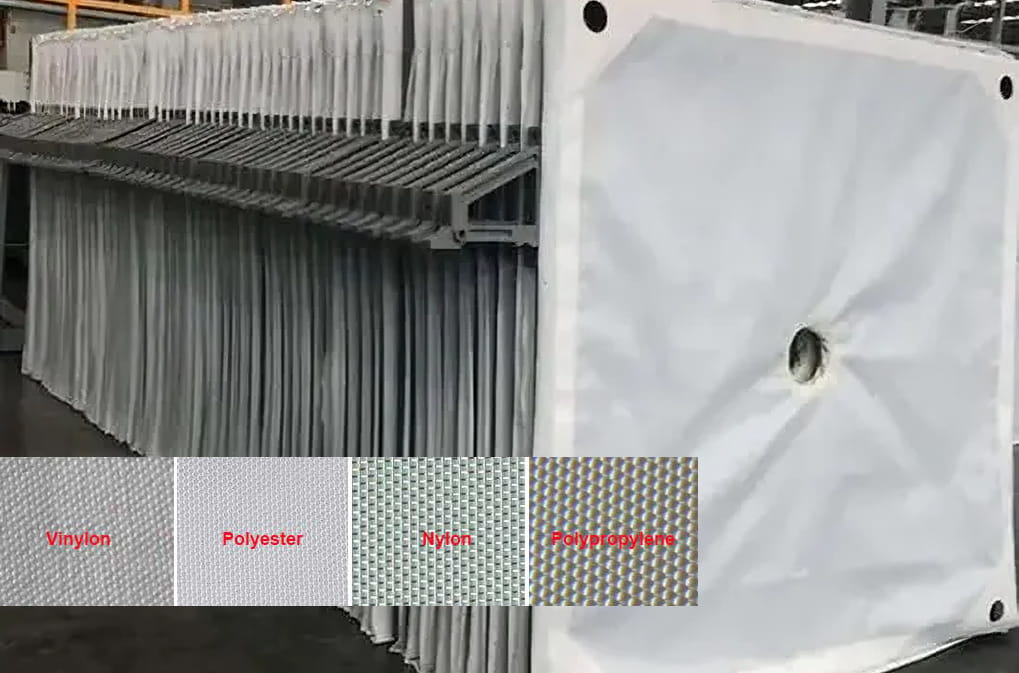
The 4 Main Filter Press Cloth Materials (And When to Use Each)
1. Polypropylene (PP): The Versatile Workhorse
Polypropylene is like the Swiss Army knife of filter cloths.
It’s the most popular choice for a reason. This stuff handles almost anything you throw at it.
When to use it:
- Chemical processing plants
- Wastewater treatment
- Mining operations (non-abrasive)
- Food and beverage production
Key strengths:
- Excellent chemical resistance – Laughs in the face of acids and alkalis
- Hydrophobic nature – Water rolls right off, speeding up drainage
- Cost-effective – Usually 30-50% cheaper than other materials
- Easy to clean – Cake practically falls off
The downsides:
- Temperature limit around 90°C (194°F)
- Not great with abrasive materials
- Can stretch under heavy mechanical stress
I’ve seen polypropylene cloths run for 2+ years in the right application. But put them in a high-temperature environment? They’ll fail within weeks.
Pro Tip: If your process runs below 80°C and doesn’t involve sharp particles, polypropylene should be your first choice. The cost savings alone make it worth considering.
2. Polyester (PET): The High-Temperature Champion
Need to handle heat? Polyester’s your answer.
This material shines when polypropylene would melt into a puddle.
Perfect for:
- High-temperature chemical processes
- Metallurgy applications
- Pharmaceutical production
- Fine particle retention
What makes it special:
- Temperature resistance up to 150°C (302°F)
- Superior strength – Handles high pressure like a boss
- Precise filtration – Catches particles others miss
- Dimensional stability – Doesn’t stretch or deform
Watch out for:
- Hydrolysis in hot, alkaline conditions
- Higher initial cost
- Slightly harder cake release than PP
Here’s a real-world example: A chemical plant switched from PP to polyester for their 120°C process. Result? Cloth life jumped from 3 weeks to 8 months.
3. Nylon (Polyamide): The Abrasion Fighter
Got sharp, nasty particles? Nylon enters the chat.
This is your heavy-duty option when other materials would get shredded.
Ideal applications:
- Mining with abrasive ores
- Ceramic slurries
- Sand and aggregate washing
- Any process with sharp particles
Why it rocks:
- Unmatched abrasion resistance – Tough as nails
- High elasticity – Bounces back from mechanical stress
- Smooth surface – Excellent cake release
- Long life in harsh conditions
The trade-offs:
- Poor acid resistance (seriously, keep acids away)
- Most expensive option
- Overkill for non-abrasive applications
I recently worked with a copper mine that was burning through PP cloths every month. Switched to nylon? They’re still using the same cloths 14 months later.
4. Cotton: The Specialty Player
Cotton’s the oddball of the bunch. Rarely used, but sometimes exactly what you need.
Limited uses:
- Low-temperature, neutral pH processes
- Applications requiring natural fibers
- Temporary or short-term filtration
- Budget-conscious operations (initially)
The good:
- Natural fiber if that matters for your process
- Swells when wet for tight seal
- Biodegradable
- Low upfront cost
The bad:
- Terrible chemical resistance
- Prone to rot and mildew
- Short lifespan
- Not suitable for industrial use
Honestly? Unless you have a very specific need for natural fibers, skip cotton. The other three materials run circles around it.
How to Choose the Right Filter Press Cloth Material (Step-by-Step)
Alright, let’s get practical.
Here’s my proven process for selecting the perfect cloth material:
Step 1: Analyze Your Process Conditions
First things first. You need to know exactly what you’re dealing with.
Answer these questions:
- Operating temperature? (This alone might narrow it down)
- pH range? (Acidic, neutral, or alkaline?)
- Particle characteristics? (Size, shape, abrasiveness)
- Chemical exposure? (List all chemicals present)
- Pressure requirements? (Low, medium, or high)
Write these down. Seriously. This information is gold.
Step 2: Match Material Properties to Your Needs
Now comes the matching game.
Here’s a quick decision tree:
Temperature above 90°C? → Polyester or Nylon
Highly abrasive particles? → Nylon
Strong acids or alkalis? → Polypropylene or Polyester (for acids)
Budget conscious + standard conditions? → Polypropylene
Food-grade requirements? → Polypropylene or special-grade Polyester
Step 3: Consider Secondary Factors
Beyond the basics, think about:
- Cake release requirements (Monofilament vs. multifilament)
- Filtrate clarity needs (Tighter weaves for cleaner filtrate)
- Cleaning frequency (Some materials clean easier)
- Available downtime (Longer-lasting materials = less downtime)
Step 4: Calculate True Cost
Don’t just look at purchase price.
Calculate the total cost including:
- Initial cloth cost
- Expected lifespan
- Downtime for changes
- Cleaning requirements
- Lost production
A cloth that costs twice as much but lasts four times longer? That’s a winner.
Step 5: Test Before Committing
Never go all-in without testing.
Order a few test cloths. Run them for at least a month. Monitor:
- Filtration quality
- Cycle times
- Cake moisture
- Cloth condition
- Cleaning ease
The data you gather will pay for itself many times over.
Advanced Filter Press Cloth Selection: Going Beyond the Basics
Ready to level up? Let’s talk about the finer points.
Yarn Types: The Hidden Performance Factor
The yarn construction matters almost as much as the material itself.
Monofilament yarns:
- Single, smooth strands
- Excellent cake release
- Easy to clean
- Lower particle retention
- Best for coarse filtration
Multifilament yarns:
- Multiple twisted fibers
- Superior particle capture
- Higher flow resistance
- Harder to clean
- Ideal for fine filtration
The sweet spot? Mono-multifilament combinations. You get decent cake release AND good filtration.
Weave Patterns That Make a Difference
Not all cloths are woven the same.
Plain weave: Simple over-under pattern. Good all-around performance.
Twill weave: Diagonal pattern. Better strength and flexibility.
Satin weave: Smooth surface. Excellent cake release but lower strength.
For most applications, plain weave works great. But if you need extra strength or specific release characteristics, explore other options.
Permeability: Finding the Goldilocks Zone
Too permeable? Your filtrate looks terrible.
Not permeable enough? Cycle times skyrocket.
The trick is matching permeability to your particle size distribution.
General guidelines:
- Fine particles (<10 microns): 20-50 CFM permeability
- Medium particles (10-100 microns): 50-150 CFM
- Coarse particles (>100 microns): 150+ CFM
But remember: These are starting points. Your specific process might need adjustments.
Real-World Success Stories
Let me share a few wins from the field.
Case 1: Chemical Plant Transformation
A specialty chemical manufacturer was struggling with PP cloths lasting only 6 weeks. The problem? Their process occasionally spiked to 95°C.
We switched to polyester cloths with a special heat-stabilized construction. Result?
- Cloth life: 6 weeks → 9 months
- Annual savings: $45,000
- Downtime reduction: 60%
Case 2: Mining Operation Breakthrough
A gold mine was replacing PP cloths every 3-4 weeks due to abrasive ore. The constant changes were killing productivity.
The fix? Premium nylon cloths with reinforced seams.
- Cloth life: 1 month → 15 months
- Production increase: 12%
- ROI: 300% in year one
Case 3: Wastewater Treatment Win
A municipal plant needed better cake release without sacrificing filtration quality. Their multifilament PP cloths required extensive cleaning.
Solution? Mono-multifilament PP with optimized permeability.
- Cleaning time: 2 hours → 30 minutes
- Cake moisture: 25% → 22%
- Operator satisfaction: Through the roof
Common Mistakes to Avoid
I’ve seen these errors cost companies big time:
Mistake #1: Choosing based on price alone
That bargain cloth? It might cost you 10x more in downtime and replacements.
Mistake #2: Ignoring temperature spikes
Your process runs at 70°C… except for those weekly cleaning cycles at 100°C. Guess when your PP cloth fails?
Mistake #3: Over-specifying
Using nylon for non-abrasive applications is like driving a tank to the grocery store. Unnecessary and expensive.
Mistake #4: Forgetting about chemical compatibility
I’ve seen strong acids eat through the wrong cloth material in days. Always check compatibility charts.
Mistake #5: Not considering the full system
Your cloth needs to work with your specific plates, press design, and process conditions. It’s not just about the fabric.
Maintenance Tips for Maximum Filter Press Cloth Life
Even the best filter press cloth material needs proper care.
Here’s how to maximize lifespan:
- Regular inspections – Catch problems early
- Proper tensioning – Too tight = premature failure
- Gentle cleaning – High pressure can damage fibers
- Chemical compatibility – Use appropriate cleaning agents
- Rotation schedule – Distribute wear evenly
- Proper storage – Keep spare cloths dry and clean
A well-maintained cloth can last 2-3x longer than a neglected one. That’s pure profit in your pocket.
Making the Final Decision
Choosing the right filter press cloth material doesn’t have to be complicated.
Start with your process conditions. Match them to material properties. Test before committing. And always consider total cost of ownership.
Remember: The right cloth turns your filter press from a maintenance headache into a reliable workhorse.
Whether you go with versatile polypropylene, high-temperature polyester, ultra-tough nylon, or specialty options, make sure it aligns with your specific needs.
The few extra hours spent on selection will pay dividends for years to come. Your maintenance team will thank you. Your accountant will thank you. And your filter press will run like it’s supposed to.
Ready to upgrade your filtration game? Start with the right filter press cloth material. Everything else follows from there.



 English
  German
  Spanish
  French
  Italian
  Russian
  Turkish
  Dutch
Dutch  Polish