
So you need to know how to use a filter press?
Maybe you just invested in one for your facility. Or perhaps you’re researching whether a filter press is right for your operation.
Either way, you’re in the right place.
In this guide, as a professional filter press manufacturer, I’ll walk you through exactly how to operate a filter press from start to finish. No fluff. Just actionable steps you can use today.
Let’s dive in.
What Is a Filter Press (And Why Should You Care)?
Before we get into the nitty-gritty of operation, let’s quickly cover what a filter press actually does.
A filter press is industrial equipment that separates solids from liquids using pressure filtration.
Think of it like a super-powered coffee filter on steroids.
You pump in a slurry (that’s your mixture of solids and liquids). The machine applies pressure. The liquid passes through special filter cloths. And the solids? They stay behind, forming what we call a “filter cake.”
Pretty simple concept. But INSANELY effective.
Here’s why this matters:
Industries from mining to food processing rely on filter presses for efficient dewatering. We’re talking about equipment that can process thousands of gallons per day with minimal operator involvement.
The best part?
Once you know the basics, operating a filter press is surprisingly straightforward.
The Main Components You Need to Know
Look, I get it.
Industrial equipment can seem intimidating at first glance.
But here’s the thing: filter presses only have a few key components you actually need to understand.
Filter Plates
These are the heart of your system. Filter plates come in two main varieties:
Chamber plates (also called recessed plates) have indentations that create chambers when pressed together.
Membrane plates have a flexible membrane that can inflate for extra squeezing action.
Most operations use a combination of both. The plates stack together like a deck of cards, creating multiple filtration chambers.
Filter Cloth
This is where the magic happens.
Filter cloths drape over each plate. They’re the actual filtering medium that traps solids while letting liquids pass through.
Different materials work better for different applications. Polypropylene works great for most applications. But you might need specialized cloths for aggressive chemicals or high temperatures.
Feed Pump
Your feed pump is the muscle of the operation. It pushes slurry into the press under pressure.
Most facilities use either:
- Air-operated diaphragm pumps
- Centrifugal pumps
- Progressive cavity pumps
Each has its pros and cons. But for most applications, an air diaphragm pump offers the best balance of reliability and cost.
Hydraulic System
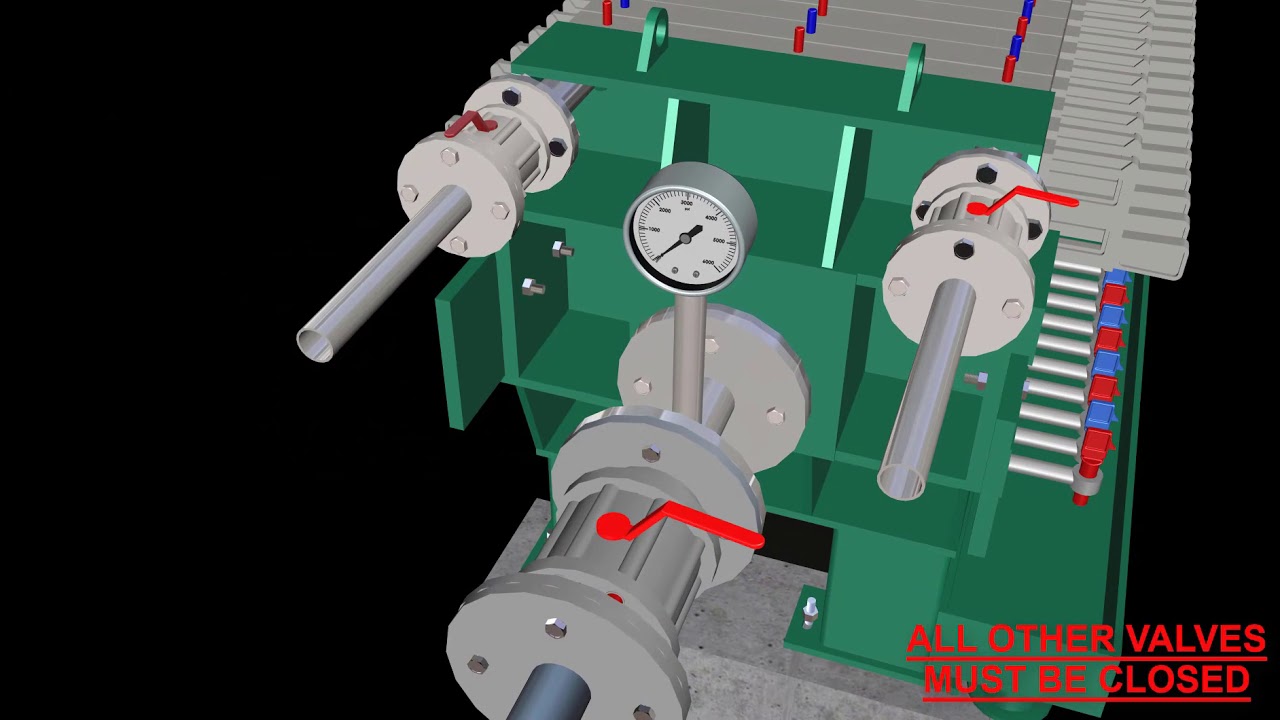
The hydraulic system (or mechanical jack on smaller units) provides the clamping force that holds everything together during filtration.
No pressure = leaky mess.
Too much pressure = damaged equipment.
Getting this right is crucial.
How to Use a Filter Press: Step-by-Step Operation Guide
Now for the good stuff.
Here’s exactly how to operate a filter press from start to finish:
Step 1: Pre-Operation Inspection
First things first: safety check.
Walk around your press. Look for:
- Damaged filter cloths
- Misaligned plates
- Debris between plates
- Proper plate sequence (they should alternate)
I can’t stress this enough:
A 5-minute inspection can save you hours of cleanup and thousands in repairs.
Step 2: Close the Press
Time to button things up.
Activate your hydraulic system to close the plates. You want firm, even pressure across the entire stack.
For most presses, you’re looking at:
- 4,000 PSI for automatic systems
- 6,500 PSI for manual units
Watch for plates sticking out or gaps between them. If you see either, stop and realign before proceeding.
Step 3: Start Filtration
Here’s where things get interesting.
Start your feed pump at LOW pressure. I’m talking 25 PSI max.
Why so low?
Because you need to build your filter cake gradually. Rush this step and you’ll blind your cloths faster than you can say “maintenance nightmare.”
As the chambers fill, gradually increase pressure:
- 25 PSI for the first few minutes
- 50 PSI once flow is established
- 75 PSI as cake builds
- 100 PSI maximum for final dewatering
Pro tip: Listen to your pump. When it slows from rapid strokes to maybe one every 30-60 seconds, you’re nearly full.
Step 4: Optional Cake Washing
Not every operation needs this step.
But if you’re recovering valuable materials or need ultra-pure cake, washing is your friend.
The process is simple:
- Stop the feed pump
- Introduce wash water through the same feed port
- Continue until discharge runs clear
Just remember: washing adds cycle time. Only do it if your process truly requires it.
Step 5: Cake Compression (Membrane Plates Only)
Got membrane plates?
This is where they earn their keep.
Inflate the membranes with compressed air or water (typically 100-225 PSI). This squeezes out additional moisture, dropping cake moisture by another 5-10%.
For operations where every percentage point of dryness matters, this step is gold.
Step 6: Cake Blow Down
Almost there.
Close your outlet valves. Open the air blow valve. Send compressed air through the system for 10-15 minutes.
This accomplishes two things:
- Removes residual liquid from the cake
- Breaks the cake away from the cloths for easier discharge
Skip this step and you’ll be scraping sticky cake off your cloths. Trust me, I’ve been there.
Step 7: Open and Discharge
The moment of truth.
Release hydraulic pressure. Retract the closing mechanism. Carefully separate the plates one by one.
If you did everything right, the filter cake should fall out on its own. Maybe a gentle tap here and there.
Heavy scraping? That’s a sign something went wrong earlier in the process.
Step 8: Clean and Inspect
Before starting your next cycle:
- Check cloths for damage or blinding
- Clear any cake residue
- Verify all plates are clean
- Ensure drainage ports are clear
Some operations run automatic cloth washing systems. Others rely on manual cleaning. Either way, don’t skip this step.
Troubleshooting Common Issues
Even with perfect operation, things go wrong.
Here are the most common issues and how to fix them:
Wet or Uneven Cakes
Seeing moisture variations across your cake?
Usually means:
- Damaged filter cloths
- Improper plate alignment
- Inconsistent feed quality
Start by checking your cloths. Even pinholes can cause major issues.
Premature Pressure Build-Up
If pressure spikes before your chambers are full, you’ve got a flow restriction.
Check for:
- Blinded cloths (too many fines)
- Incorrect cloth selection
- Feed material changes
Sometimes switching to a more open cloth weave solves everything.
Cake Sticking to Cloths
Nobody likes scraping cake for 20 minutes.
This usually indicates:
- Insufficient blow-down time
- Wrong cloth material
- Need for cloth replacement
A good release agent can help. But if you’re constantly fighting sticky cake, it’s time to reevaluate your cloth selection.
Maximizing Your Filter Press Performance
Want to squeeze every ounce of performance from your press?
Here’s what separates the pros from the amateurs:
Optimize Your Feed Consistency
Garbage in, garbage out.
Your filter press performs best with consistent feed material. Wild swings in solids content or particle size murder efficiency.
Consider adding a thickener or clarifier upstream. Yes, it’s an extra step. But the improvement in press performance usually justifies the investment.
Dial In Your Pressure Progression
Remember those pressure steps I mentioned?
They’re not set in stone.
Every application is different. Start with my recommendations, then adjust based on your results. Keep detailed logs. Find your sweet spot.
Choose the Right Filter Cloth
I see this mistake constantly:
People pick filter cloths based solely on micron rating.
But permeability matters just as much. So does cake release. And chemical compatibility. And temperature resistance.
Work with your cloth supplier. Get samples. Test thoroughly. The right cloth can double your run time between cleanings.
Maintain Proper Temperature
Here’s something most guides won’t tell you:
Temperature is crucial for filter press performance.
Most slurries filter best between 140-180°F. Too cold and viscosity kills your flow rate. Too hot and you might damage cloths or seals.
Advanced Techniques for Power Users
Ready to level up?
These advanced strategies separate good operators from great ones:
Pre-coating for Difficult Materials
Dealing with slimy or ultra-fine materials?
Try pre-coating your cloths with diatomaceous earth or perlite. Create a thin layer before introducing your actual feed.
Game changer for tough applications.
Variable Chamber Technology
Some modern presses allow you to adjust chamber volume on the fly.
Start with larger chambers for initial filling. Compress down for final dewatering. It’s like having two presses in one.
Multi-Stage Filtration
Who says you need just one press?
For really challenging separations, consider running filtrate through a second, tighter press. Or use different pressure profiles for different material fractions.
Safety Considerations You Can’t Ignore
Look, filter presses are generally safe equipment.
But “generally safe” doesn’t mean “idiot-proof.”
Always:
- Lock out energy sources during maintenance
- Wear appropriate PPE (safety glasses minimum)
- Keep body parts clear during closing
- Verify pressure relief devices are functional
- Train every operator thoroughly
That last point is huge.
I’ve seen more accidents from untrained operators than equipment failures. Invest in proper training. Your workers (and lawyers) will thank you.
Making the Investment Decision
Thinking about purchasing a filter press?
Here’s my take:
If you’re processing more than 1,000 gallons of slurry daily, a filter press probably makes sense. The labor savings alone justify the investment.
For smaller operations, consider:
- Renting first to validate the concept
- Buying used equipment (plenty available)
- Starting with a manual press before going automatic
Just don’t cheap out on filter cloths. Good cloths on a mediocre press outperform bad cloths on a premium press every time.
The Bottom Line
Operating a filter press isn’t rocket science.
But like any industrial process, details matter. Follow the steps I’ve outlined. Pay attention to your specific application’s quirks. Keep good maintenance records.
Do these things and your filter press will reward you with years of reliable service.
Remember: every facility is different. What works perfectly for a mining operation might fail miserably in food processing. Take these guidelines and adapt them to your specific needs.
The key is understanding the fundamentals, then fine-tuning based on experience.
Now you know exactly how to use a filter press for maximum efficiency and minimum headaches.
Your move.





 English
  German
  Spanish
  French
  Italian
  Russian
  Turkish
  Dutch
Dutch  Polish