
Principaux enseignements
- 90% des problèmes liés aux filtres-presses sont dus à seulement cinq causes fondamentales : le décollement de la toile, les problèmes de pompe, un mauvais conditionnement chimique, un mauvais alignement des plaques et une maintenance inadéquate.
- Commencez le dépannage en vérifiant la pression, en inspectant les toiles filtrantes et en vérifiant l'alignement des plaques - cela permet de résoudre la plupart des problèmes. Suivez une approche systématique : identifiez les symptômes, dressez la liste des causes potentielles, testez une variable à la fois et documentez les solutions.
- La prévention l'emporte sur la réparation - un programme d'entretien solide peut prévenir 80% des pannes avant qu'elles ne se produisent.
Vous êtes-vous déjà trouvé devant un filtre-presse défectueux en vous demandant par où commencer ?
Je comprends. Le dépannage d'un filtre-presse peut sembler insurmontable lorsque vous êtes confronté à des fuites, à une mauvaise formation du gâteau ou à un filtrat mystérieusement trouble.
Voici ce qu'il en est :
La plupart des problèmes liés aux filtres-presses suivent des schémas prévisibles. Une fois que vous savez à quoi vous attendre, il devient beaucoup plus facile de les résoudre.
Dans ce guide, en tant que professionnel fabricant de filtres-presses, Je vous guiderai dans le processus de dépannage exact que j'ai vu fonctionner dans des centaines d'établissements. Rien de superflu. Juste des solutions concrètes qui fonctionnent vraiment.
Plongeons dans le vif du sujet.
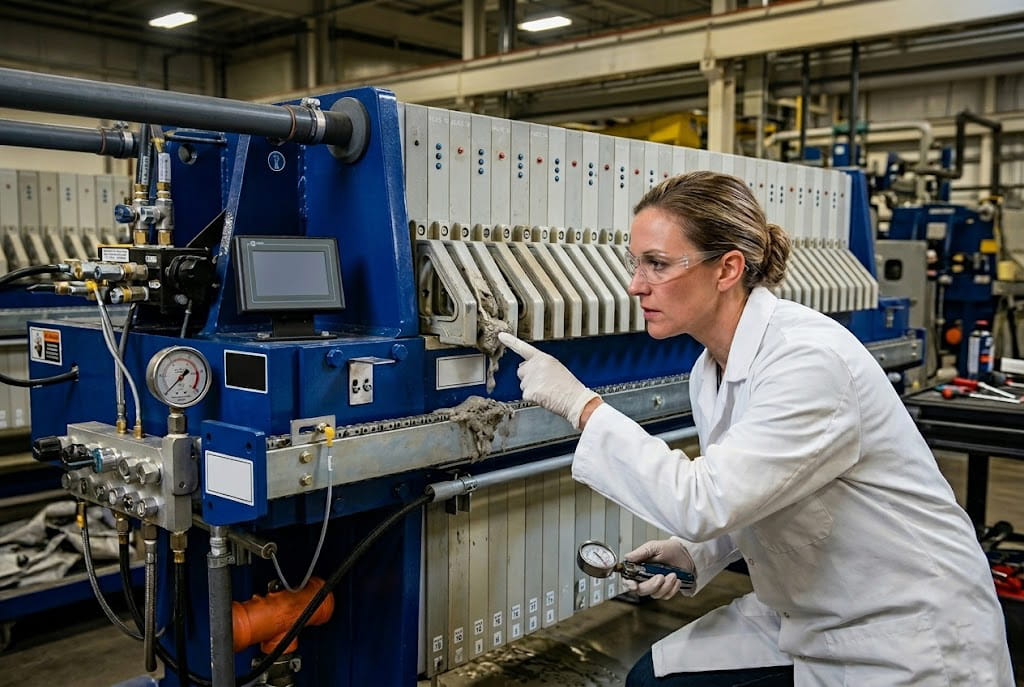
Pourquoi votre filtre-presse ne cesse de tomber en panne (et ce qu'il faut faire)
Voici une chose que la plupart des gens ne réalisent pas :
90% des problèmes liés aux filtres-presses sont dus à seulement 5 causes fondamentales.
Je parle de.. :
- Cécité et usure de la toile
- Problèmes de pompe et de pression
- Mauvais conditionnement chimique
- Désalignement de la plaque
- Entretien inadéquat
La bonne nouvelle ? Chacun de ces problèmes présente des signes d'alerte clairs. Et des solutions encore plus claires.
Permettez-moi de vous présenter les problèmes les plus courants que vous rencontrerez (et la manière exacte de les résoudre).
Dépannage du filtre-presse : 5 problèmes courants
Problème #1 : Votre filtre-presse ne monte pas en pression
C'est le problème le plus frustrant auquel les opérateurs sont confrontés.
Vous démarrez un cycle. La pompe fonctionne. Mais la pression reste obstinément basse.
Cela vous rappelle quelque chose ?
Voici ce qui se passe habituellement :
Votre pompe d'alimentation ne peut pas fournir une pression suffisante en raison de l'usure, de blocages ou de la présence d'air dans le système.
(En fait, l'air emprisonné est à l'origine de 30% de problèmes de pression. C'est fou, non ?).
La solution :
Commencez par vérifier votre pompe. Fait-elle des bruits inhabituels ? Elle chauffe ? Ce sont là des signes évidents d'usure interne.
Ensuite, purgez votre système. Ouvrez les vannes d'aération et laissez l'air emprisonné s'échapper.
Toujours des problèmes ?
Il est temps d'inspecter votre boue. Les boues épaisses et visqueuses ont besoin d'une pression plus importante pour être filtrées correctement. Essayez de la diluer légèrement et voyez ce qui se passe.
Conseil de pro : installez un manomètre au niveau du refoulement de votre pompe. Cela vous permet de repérer instantanément les chutes de pression.
Problème #2 : Fuites entre les plaques filtrantes
Il n'y a rien qui puisse gâcher votre journée plus rapidement que du lisier qui se répand partout.
Mais voilà :
Les fuites de plaques sont presque toujours évitables.
Causes courantes :
- Joints usés (le coupable #1)
- Plaques désalignées
- Bords de la toile abîmés
- Pression d'alimentation excessive
Comment réparer les plaques qui fuient :
Commencez par le plus évident : inspectez vos joints. Les moindres entailles ou déformations de compression peuvent provoquer des fuites importantes.
Vous avez trouvé des joints endommagés ? Remplacez-les immédiatement.
(N'essayez pas de vous “débrouiller” avec des joints défectueux, croyez-moi, cela ne vaut pas la peine).
Vérifiez ensuite l'alignement des plaques. Utilisez une règle pour vous assurer que les plaques sont parfaitement parallèles. Un défaut d'alignement de 1/8″ peut entraîner des fuites.
Enfin, examinez vos toiles filtrantes. Des bords déchirés ou une mauvaise installation garantissent pratiquement des fuites.
Problème #3 : Mauvaise qualité du filtrat (trouble ou contaminé)
Vous obtenez un filtrat trouble alors que vous avez besoin d'un liquide cristallin ?
Ce problème rend les opérateurs fous. Et pour cause, il peut entraîner l'arrêt de l'ensemble du processus en aval.
Voici les causes d'un mauvais filtrat :
- Mauvaise sélection du tissu filtrant
- Tissu endommagé ou troué
- Pré-revêtement inadéquat
- Percée des particules fines
La solution :
Tout d'abord, prélevez un échantillon de votre filtrat et comparez-le à vos spécifications. Vous obtiendrez ainsi une base de référence.
Inspectez maintenant vos tissus filtrants. Même des trous d'épingle peuvent laisser passer des particules.
Vous avez constaté des dégâts ? Remplacez ces chiffons au plus vite.
Mais si vos tissus ont l'air en bon état, le problème réside probablement dans le choix du tissu.
En effet, des applications différentes nécessitent des taux de micron différents. Utiliser un tissu de 25 microns pour des particules de 5 microns ? Vous obtiendrez un filtrat trouble à chaque fois.
Test rapide : Essayez un tissu filtrant plus fin sur une chambre. Si la qualité du filtrat s'améliore, vous avez trouvé le problème.
Problème #4 : Blindage des toiles filtrantes
L'aveuglement des tissus est sournois.
Il démarre lentement. Les temps de cycle augmentent. La pression augmente. Et soudain, votre presse ne filtre presque plus.
Pourquoi les chiffons sont aveugles :
- Les particules fines obstruent les pores
- Surdosage en polymère (crée cette couche visqueuse)
- Contamination par l'huile et la graisse
- Nettoyage inadéquat
Comment réparer les chiffons aveuglés :
La solution la plus rapide ? Le lavage à l'acide.
Mélangez une solution d'acide chlorhydrique de 4-5%. Passez-la dans votre presse (ou faites tremper les plaques pendant une nuit).
Cela permet de dissoudre les dépôts minéraux et d'éliminer l'accumulation de polymères.
En cas de contamination huileuse, essayez d'abord d'utiliser de l'eau chaude avec un détergent dégraissant.
Cela ne fonctionne toujours pas ?
Vos chiffons sont peut-être irrécupérables. Mais avant de les remplacer, essayez ceci :
Installez un test de perméabilité à l'air. Ce test indique exactement le degré d'encrassement de vos toiles, ce qui permet d'éviter toute incertitude quant au calendrier de remplacement.
Problème #5 : Gâteau collé aux toiles filtrantes
Rien ne ralentit les opérations comme le fait de racler manuellement le gâteau sur chaque assiette.
(J'ai vu des équipes passer des heures sur ce point, ce qui n'est pas amusant).
Causes courantes :
- Humidité excessive dans le gâteau
- Mauvais type de tissu
- Mauvaises propriétés de démoulage des gâteaux
- Surcompression
La solution :
Commencez par vérifier l'humidité de votre gâteau. Prenez un échantillon et testez-le.
Trop humide ? Prolongez le temps de soufflage. Cette seule mesure peut résoudre 50% des problèmes de collage.
Ensuite, il faut tenir compte du tissu filtrant. Certains matériaux (comme le polypropylène) libèrent naturellement le gâteau mieux que d'autres.
Pour les applications difficiles, essayez les chiffons calandrés ou enduits. Ils sont spécialement conçus pour se détacher facilement.
Conseil de pro : Une légère couche préalable de terre de diatomées peut faire des merveilles pour les matériaux collants.
Techniques avancées de dépannage
Parlons maintenant des questions qui laissent perplexes même les opérateurs expérimentés.
Formation inégale des gâteaux
Vous est-il déjà arrivé d'ouvrir votre presse et de trouver dans certaines assiettes des gâteaux épais et dans d'autres des gâteaux minces comme du papier ?
Cela nuit à votre efficacité.
La cause première : Distribution inégale du lisier.
Les orifices d'alimentation sont peut-être partiellement obstrués. Ou bien la pression du collecteur varie d'une presse à l'autre.
Réparez cela par :
- Nettoyer soigneusement TOUS les orifices d'alimentation
- Installation de manomètres en plusieurs points
- Vérification de l'absence de blocage des plaques internes
- Assurer un mélange homogène des boues
Problèmes du système hydraulique
Les filtres-presses modernes reposent sur des systèmes hydrauliques. En cas de défaillance, tout s'arrête.
Attention à ces signes avant-coureurs :
- Mouvement lent ou saccadé de la plaque
- Fuites d'huile autour des cylindres
- Surchauffe de l'huile hydraulique
- Bruits inhabituels de la pompe
Solutions rapides :
- Vérifier le niveau d'huile et faire l'appoint si nécessaire
- Remplacer immédiatement les joints usés
- Nettoyer ou remplacer les filtres encrassés
- Vérifier la viscosité de l'huile
(N'oubliez pas que les problèmes hydrauliques coûtent vite cher. N'ignorez pas les signes avant-coureurs).
Usure prématurée des plaques
Le remplacement des plaques n'est pas bon marché. C'est pourquoi, lorsqu'elles s'usent précocement, cela fait mal.
Quelles sont les causes de l'usure prématurée ?
- Boues abrasives
- Attaque chimique
- Pression excessive
- Soutien insuffisant des fondations
Prolonger la durée de vie des plaques
- Utilisation de matériaux de plaque adaptés à votre application
- Maintien d'une pression de service correcte
- Assurer des fondations planes et stables
- Inspection et rotation régulières
Programme d'entretien de votre filtre-presse
Vous voulez éviter 80% ces problèmes ?
Suivez ce calendrier d'entretien :
Tous les jours :
- Inspection visuelle des fuites
- Vérifier le niveau d'huile hydraulique
- Contrôler les temps de cycle
Hebdomadaire :
- Orifices d'alimentation propres
- Inspecter les toiles filtrantes
- Tester la qualité du filtrat
Mensuel :
- Lubrifier les pièces mobiles
- Vérifier l'alignement de la plaque
- Nettoyer les filtres hydrauliques
Trimestrielle :
- Nettoyage en profondeur des filtres
- Inspecter tous les joints d'étanchéité
- Étalonnage des manomètres
Annuellement :
- Remplacer les chiffons usés
- Révision du système hydraulique
- Inspection professionnelle
Le point sur le dépannage des filtres-presses
Voici ce que je veux que vous reteniez :
La plupart des problèmes liés aux filtres-presses ne sont pas mystérieux. Ils suivent des schémas.
Apprenez ces modèles et vous réglerez les problèmes dix fois plus vite.
Commencez par les principes de base - pression, chiffons et alignement. Ils permettent de résoudre 90% de problèmes.
Pour tout le reste ?
Utilisez l'approche systématique que j'ai décrite ci-dessus. Vérifiez une variable à la fois. Documentez ce qui fonctionne.
Et n'oubliez pas :
La prévention l'emporte toujours sur la réparation. Un programme d'entretien solide est rentabilisé par les temps d'arrêt évités.
Vous avez un problème spécifique de filtre-presse que je n'ai pas abordé ? Les principes de dépannage restent les mêmes :
- Identifier précisément les symptômes
- Liste des causes potentielles
- Tester systématiquement
- Documenter votre solution
Maîtrisez ce processus et vous serez en mesure de relever tous les défis posés par votre filtre-presse.
Car en fin de compte, un dépannage efficace des filtres-presses ne consiste pas à connaître tous les problèmes possibles, mais à penser systématiquement et à prendre des mesures en fonction de ce que vous observez.





 French
  English
  German
  Spanish
  Italian
  Russian
  Turkish
  Dutch
Dutch  Polish