
So you’re looking at dewatering equipment and wondering whether a belt press or filter press is the right choice for your operation.
Es geht um Folgendes:
Both systems can effectively separate solids from liquids. But they work in completely different ways. And choosing the wrong one can cost you thousands in wasted energy, maintenance headaches, and disposal fees.
I’ve spent years analyzing industrial dewatering systems. And in this guide, as a professional Filterpressenhersteller, I’ll break down exactly how belt press vs filter press systems compare – so you can pick the perfect solution for your needs.
Quick Summary:
- Belt presses: continuous, lower capital, higher polymer and labor needs, 35–40% cake moisture, better for steady high-volume flows where moderate dryness is acceptable.
- Filter presses: batch, higher capital and footprint, much drier cake (15–20%), lower polymer/operating costs, often lower 10‑year TCO when disposal fees matter.
- Key risk areas: underestimating polymer and disposal costs, neglecting pilot testing, and ignoring maintenance access and space needs.
- Recommendation: run sludge-specific pilot tests and a 10‑year cost comparison (including disposal, polymer, energy, labor, and maintenance) to select the appropriate system.
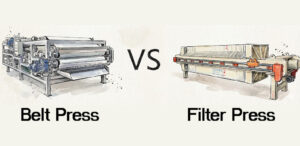
Belt Press vs Filter Press: Quick Comparison
Let me start with the basics.
A belt press is a continuous dewatering machine that squeezes sludge between two tensioned belts. Think of it like a giant rolling pin that never stops moving.
A filter press? It’s a batch system that pumps sludge into chambers and uses serious pressure to squeeze out water. Picture a massive waffle iron that opens and closes.
Hier ist ein schneller Vergleich:
Belt Press:
- Continuous operation (24/7 if needed)
- Lower pressure (typically 3-7 bar)
- Produces cake with 35-40% moisture
- Lower upfront cost
Filter Press:
- Batch operation (stop-start cycles)
- High pressure (up to 15-25 bar)
- Produces cake with 15-20% moisture
- Höhere Erstinvestition
The bottom line? Belt presses are marathon runners. Filter presses are power lifters.
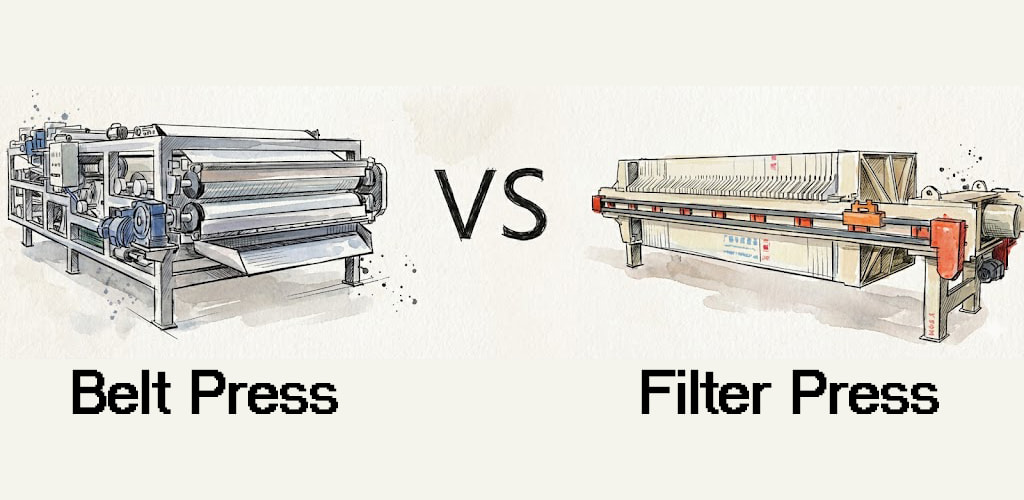
Belt Press vs Filter Press: Ultimate Comparative Analysis
Working Principle Compare
How Belt Press Systems Actually Work
Belt presses use a three-stage process that’s surprisingly simple:
Stage 1: Gravity Drainage
First, your sludge gets spread onto a moving belt. Free water drains through the belt by gravity alone. No pressure needed yet.
Stage 2: Wedge Zone
The sludge then enters a wedge-shaped area where two belts converge. This gradually increases pressure and starts the real dewatering.
Stage 3: High-Pressure Zone
Finally, the belts pass through a series of rollers. Each roller applies more pressure, squeezing out water like a tube of toothpaste.
Pro Tip: The entire process takes just 2-3 minutes from start to finish. That’s why belt presses can handle such high volumes.
Understanding Filter Press Technology
Filter presses work completely differently:
Step 1: Filling
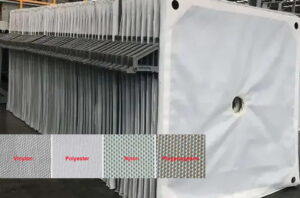
A high-pressure pump fills chambers between filter plates with sludge. The chambers are lined with filter cloth that lets water through but traps solids.
Step 2: Filtration
Pressure builds up (usually 7-15 bar), forcing water through the cloth. Solids form a “cake” inside each chamber.
Step 3: Cake Discharge
Once filtration is complete, the plates separate. The dewatered cake falls out. Then the cycle starts again.
Here’s what makes filter presses unique:
The batch process means downtime between cycles. But the high pressure creates much drier cake. We’re talking 15-20% moisture vs 35-40% from a belt press.
(And trust me, that moisture difference is HUGE when you’re paying disposal fees by the ton.)
Belt Press vs Filter Press: Key Performance Differences
Let’s dive into the nitty-gritty performance metrics:
Cake Dryness
Filter presses win hands down. A study by the Water Research Foundation found that filter presses consistently produce cake with 50-60% less moisture than belt presses.
Warum ist das wichtig?
Because every percentage point of moisture you remove saves money on:
- Kosten der Beseitigung
- Transportation fees
- Potential revenue (if you can sell the dried solids)
Processing Speed
Belt presses crush it here. They can process 50-500 gallons per minute continuously. Filter presses? They need 2-4 hour cycles, including:
- 30-60 minutes filling
- 60-120 minutes pressing
- 30 minutes cake discharge
Chemical Usage
This surprised me when I first learned it:
Belt presses typically need MORE polymer conditioning. We’re talking 15-30 lbs per dry ton vs 5-15 lbs for filter presses.
That’s because belt presses rely on flocculation to work properly. Filter presses use brute force pressure instead.
Energy Consumption
Belt presses use less energy overall. They run at lower pressures and don’t need high-pressure feed pumps.
Typical numbers:
- Belt press: 5-10 kWh per dry ton
- Filter press: 15-25 kWh per dry ton
But remember – filter presses produce drier cake, which can offset the energy costs through reduced hauling.
Belt Press vs Filter Press: Applications Comparison
In my experience, certain applications clearly favor one technology over the other.
Best Uses for Belt Presses:
- Municipal wastewater plants – High volumes, continuous flow
- Food processing waste – Soft, organic materials
- Paper mill sludge – Consistent feed, high throughput needed
- Industrial pretreatment – When 35-40% dryness is acceptable
Belt presses excel when you have:
- Steady, high-volume flows
- Limited space (smaller footprint)
- Operators available for monitoring
- Less stringent dryness requirements
Best Uses for Filter Presses:
- Mining operations – Maximum water recovery critical
- Chemical processing – Hazardous materials requiring containment
- Industrial waste – When disposal costs justify higher dryness
- Remediation projects – Batch processing fits project timeline
Filter presses dominate when you need:
- Maximum cake dryness
- Minimal operator attention
- Contained, automated operation
- Flexibility for varying feed rates
Belt Press vs Filter Press: Operating Costs
Jetzt wird es interessant.
Most people just look at equipment cost. Big mistake.
Let me break down the REAL costs over 10 years for a typical 100 GPM system:
Belt Press Total Cost of Ownership:
- Equipment: $200,000-$400,000
- Installation: $50,000-$100,000
- Annual polymer: $50,000-$100,000
- Annual maintenance: $20,000-$40,000
- Annual labor (2 operators): $100,000-$150,000
- Annual disposal (@ 35% solids): $200,000-$400,000
10-Year Total: $3.7M – $7.4M
Filter Press Total Cost of Ownership:
- Equipment: $300,000-$600,000
- Installation: $100,000-$200,000
- Annual polymer: $20,000-$40,000
- Annual maintenance: $10,000-$20,000
- Annual labor (0.5 operator): $25,000-$40,000
- Annual disposal (@ 20% solids): $120,000-$240,000
10-Year Total: $2.15M – $4.3M
Shocking, right? The “expensive” filter press often costs LESS over time.
Maintenance Requirements and Reliability
This is where the rubber meets the road (or where the belt meets the roller).
Belt Press Maintenance:
Belt presses need constant TLC:
- Daily belt washing and tension adjustments
- Weekly belt tracking corrections
- Monthly roller bearing lubrication
- Quarterly belt replacement ($10,000-$20,000)
- Annual major overhaul
One wastewater plant manager told me: “Our belt press is like a classic car – runs great when it’s tuned up, but needs constant attention.”
Filter Press Maintenance:
Filter presses are workhorses:
- Weekly plate shifting checks
- Monthly hydraulic fluid levels
- Quarterly filter cloth inspection
- Annual cloth replacement ($5,000-$15,000)
- Minimal daily maintenance
The automated operation means less wear and tear. Most filter presses run 10-15 years with just routine maintenance.
Space and Installation Considerations
Don’t overlook footprint and installation requirements.
Belt presses are compact. A 100 GPM unit fits in about 400 square feet. But you need:
- Gravity drainage for filtrate
- Easy access for belt changes
- Polymer mixing systems nearby
- Adequate ventilation (they’re open systems)
Filter presses need more space – typically 800-1,200 square feet. Plus:
- Reinforced flooring (they’re heavy when full)
- Overhead clearance for plate movement
- Contained area for cake discharge
- Feed tank with mixing capability
Pro Tip: Always plan for 50% more space than the equipment needs. You’ll thank me during maintenance.
Making the Right Choice: Decision Framework
After analyzing hundreds of installations, here’s my decision framework:
Choose a Belt Press When:
- Processing over 1 million gallons/year
- Cake moisture of 35-40% is acceptable
- You have dedicated operators
- Continuous flow is critical
- Capital budget is tight
Choose a Filter Press When:
- Maximum dryness saves significant disposal costs
- Batch processing fits your operation
- Labor costs are high
- Space isn’t severely limited
- Long-term ROI matters most
Remember: The “best” choice depends entirely on YOUR specific situation.
Advanced Considerations for 2026 and Beyond
The dewatering industry is evolving fast. Here’s what’s coming:
Intelligente Steuerelemente
New belt presses feature AI-driven optimization that adjusts belt speed and tension automatically. This can reduce polymer use by 20-30%.
Filter presses now offer remote monitoring and predictive maintenance alerts. One facility reduced downtime by 40% using these features.
Hybride Systeme
Some manufacturers now offer combination units that pre-thicken with a belt press, then finish with filter press chambers. Best of both worlds? Maybe.
Schwerpunkt Nachhaltigkeit
With disposal costs rising and regulations tightening, the extra dryness from filter presses becomes more valuable every year.
Carbon footprint matters too. Despite higher energy use, filter presses often have lower total emissions due to reduced trucking.
Häufig zu vermeidende Fehler
I’ve seen these errors cost facilities millions:
- Underestimating polymer costs – Budget for worst-case scenarios
- Ignoring disposal fees – Every percent of moisture matters
- Skimping on pilot testing – Always test with YOUR sludge
- Overlooking maintenance access – Cramped spaces triple maintenance time
- Focusing only on purchase price – Operating costs dwarf capital costs
The Bottom Line on Belt Press vs Filter Press
Here’s what it comes down to:
Belt presses offer continuous operation and lower upfront costs. They’re workhorses for high-volume operations where moderate cake dryness works.
Filter presses deliver maximum dryness and lower operating costs. They excel when disposal fees are high or when batch processing fits your workflow.
Neither is universally “better.” The right choice depends on your specific needs, budget, and long-term goals.
My advice? Run the numbers for YOUR operation. Factor in all costs over 10 years. Test both technologies with your actual sludge. Then make an informed decision.
Because when it comes to Bandpresse vs. Filterpresse selection, the details make all the difference.



 German
  English
  Spanish
  French
  Italian
  Russian
  Turkish
  Dutch
Dutch  Polish